

September 10, 2026
By Eric Willett, Managing Director; Kelsey Padgham, Principal; Isaac Gershberg, Associate
CRE C-Suite Outlook
Commercial real estate firms appear to have entered a period of strategic stasis. While elevated interest rates, selective capital markets, and persistent macroeconomic uncertainty continue to shape decision-making, this year’s survey suggests executives are less frequently rethinking fundamental assumptions around their organizations or business models. Instead, firms are learning to operate within today’s environment, maintaining disciplined cost structures, refining operations, and pursuing growth opportunities where risk-adjusted returns justify investment. Operating within a business context with stable but consistent headwinds, the strongest positioned operators are doubling down on the basics, and four years into an interest rate reset, the new normal is starting to feel, well, normal.
Stasis should not be confused with inactivity: transaction volume across most asset classes is climbing back from post-pandemic lows, capital is still being raised, teams continue to evolve, and organizations are adopting new technologies. The difference today is that these activities are occurring within relatively stable organizational and strategic frameworks rather than alongside broad restructuring or aggressive expansion. Across this year’s survey, executives consistently describe businesses that have adapted to a slower, more disciplined operating environment and are focused on incremental progress rather than transformational change.
This report synthesizes insights from 80+ survey respondents who currently hold senior leadership roles at CRE firms that, combined, represent a reported $39 billion dollars in real estate investment volume in 2024. RCLCO also conducted follow-up interviews with participants to gather additional feedback on survey themes. Our hope is that findings from the CRE C-Suite Outlook help inform boardroom conversations, capital planning, and long-term vision-setting across the real estate landscape.
Key Findings
- Groups are cautiously pursuing deals within the context of a lopsided capital markets recovery: nearly 40% say sourcing debt has gotten easier while 42% say raising equity has gotten harder.
- Nearly two-thirds of firms report no significant change to their staffing model (a notable increase from last year) as organizations settle into stable structures and disciplined spending; this underpins a broader emphasis on operations as executives pivot focus and resources away from chasing the cycle.
- Disciplined management of teams and platform investments has helped margin compression reverse: 43% of firms held margins flat and 35% improved, versus 40% reporting compression last year.
- While consolidation remains a tool in the toolkit for many C-Suites, appetite for M&A has fallen sharply, with two-thirds of firms considering no M&A activity this year, up from just under half.
- AI adoption is top of the list for executive focus. Only 3% of firms report no meaningful AI use, and nearly a quarter have reached enterprise-wide deployment—overwhelmingly aimed at productivity rather than cost reduction.
Operating Performance
Operating margins stabilized in 2025 as firms adapted to a slower transaction environment, though executives remain cautious about corporate spending amid continued market uncertainty.
“We stopped waiting for volume to bail us out and rebuilt the cost base around the market we actually have.”
Partner | Diversified Real Estate Investment Company
Operating performance has become more stable over the past several years. Compared with last year’s survey, executives report less margin compression and a much greater degree of stability. Nearly 43% of respondents indicated that operating margins remained essentially unchanged from 2024 to 2025, while approximately 35% reported some improvement. Just over one-fifth experienced declining profitability.

This represents a meaningful shift from last year’s results, when nearly 40% of respondents reported margin compression and only about one-quarter saw any improvement. Rather than continuing to absorb deteriorating economics, many operating companies appear to have recalibrated their organizations, fee structures, and expense bases to better match today’s transaction volumes.
Despite improving profitability trends, executives remain disciplined on corporate spending. Nearly one-third expect overhead expenses to remain unchanged over the coming year, while another 43% anticipate only modest increases of less than 10%. Only a small minority expect significant expansion in corporate costs. At the same time, roughly one-quarter of firms still expect to reduce overhead in some capacity, highlighting that expense management remains an important lever as organizations balance investment for growth against an uncertain capital markets backdrop.
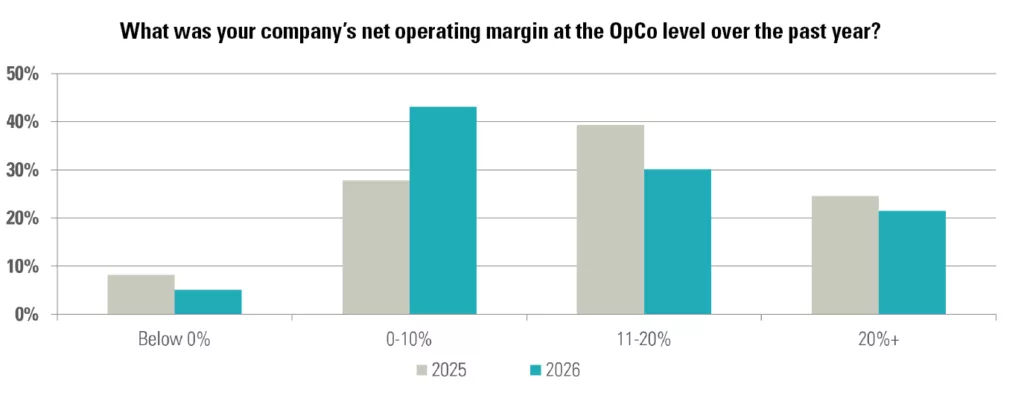
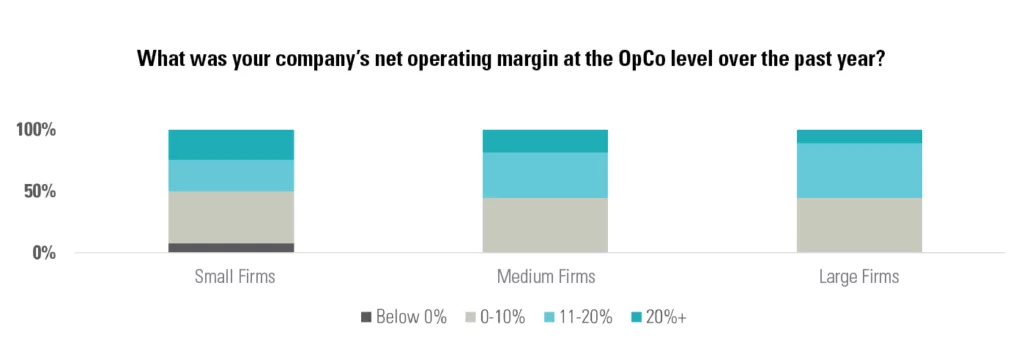
Profitability remains healthy, although operating margins have become increasingly concentrated in the middle of the distribution. Nearly all respondents remained profitable over the past year, with only 5% reporting negative operating margins. However, compared with last year’s survey, a greater share of firms report operating margins in the 0–10% range (43%, up from 28%), while fewer achieved margins between 11–20% or above 20%. Although firms have largely stabilized after several years of market disruption, many are operating with thinner cushions than in prior years. Margin profiles were broadly consistent across company sizes, though smaller firms were somewhat more likely to report both very high margins and operating losses, reflecting the greater variability that often accompanies smaller platforms.
Talent
Commercial real estate firms continue to prioritize organizational stability, with limited changes to staffing models and a sustained focus on developing and retaining existing leadership.
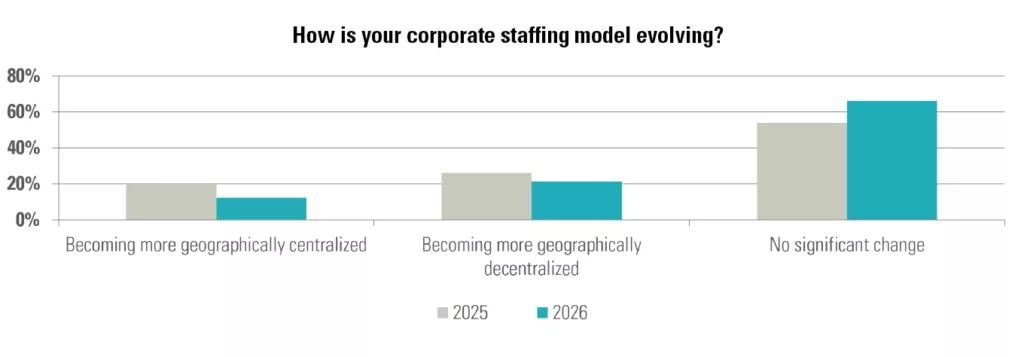
After several years of organizational adjustment, most firms appear to have settled into stable operating models. Nearly two-thirds of respondents report no significant changes to their corporate staffing model, a notable increase from last year’s survey. Among the minority of firms making organizational changes, geographic decentralization continues to outpace centralization across companies of all sizes, suggesting organizations remain committed to placing teams closer to regional markets, investments, and talent pools rather than consolidating functions at headquarters.
Hiring conditions have also remained relatively stable. Approximately one-third of executives report that attracting and retaining top talent has become somewhat or significantly easier, while roughly one-quarter continue to experience increased difficulty.
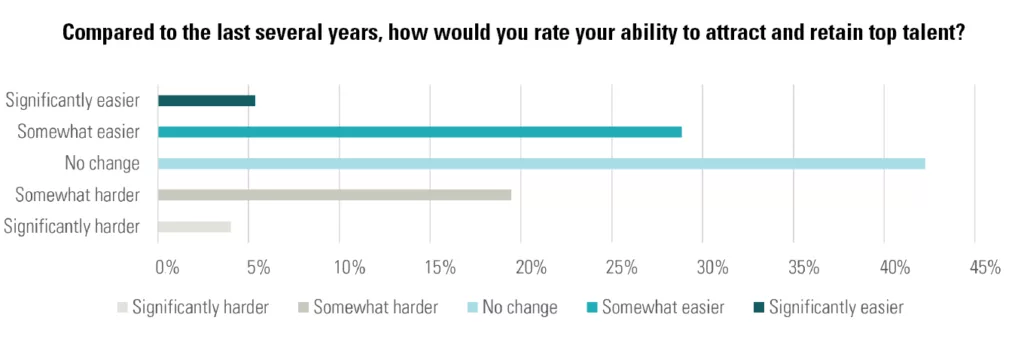
Compared with last year’s survey, talent conditions remain remarkably consistent. Executives describe a market in which key talent remains competitive but generally accessible for firms with compelling cultures and career opportunities. “We’re always looking to invest in people who can drive growth and add to the top line. There’s never a wrong time to hire good people,” said one founder.
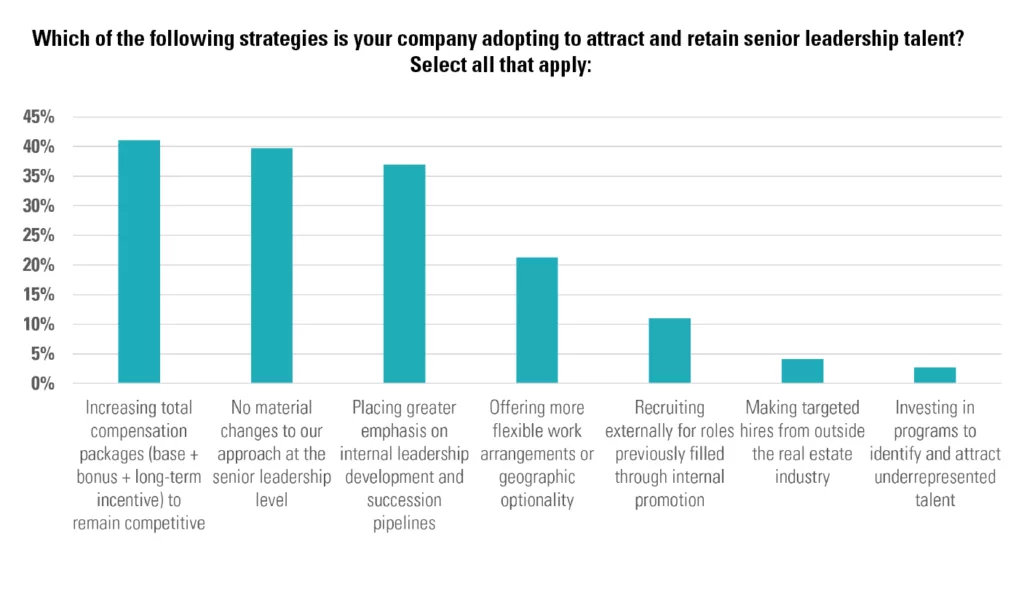
When asked about strategies for attracting and retaining senior leadership, respondents emphasize internal succession planning and leadership development alongside competitive compensation packages. These remain the two most frequently cited initiatives, while comparatively few organizations are recruiting externally or looking outside the industry for executive talent.
Executive Team
Team composition remains broadly consistent across firms, yet many organizations continue to rely on informal or reactive approaches to succession planning, highlighting the potential for leadership continuity challenges.
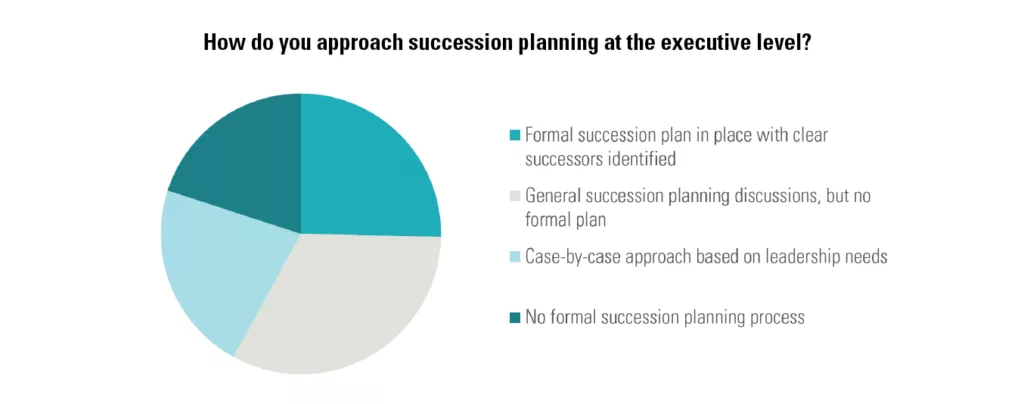
Executive leadership teams remain centered on a relatively consistent set of functional leaders. Across respondents, the CEO, CFO, and COO remain the three most common executive roles. Succession planning continues to represent an area of opportunity. Only one-quarter of respondents report maintaining a formal succession plan with clearly identified successors. Most organizations instead rely on informal discussions or case-by-case decision making, while one in five report having no formal succession planning process at all.
Capital Markets
Capital raising conditions improved meaningfully over the past year, particularly on the debt side, though equity fundraising remains selective and executives expect only gradual improvement going forward.
The fundraising environment has begun to improve after several difficult years, although the recovery remains uneven across capital sources. Compared with last year’s survey, executives report noticeably easier access to debt financing, with nearly 40% describing debt markets as somewhat or much easier than a year ago. In follow-up conversations, several respondents went so far as to describe the current debt markets as “terrific,” “exquisite,” and “robust.” Said one respondent, “The debt markets are in great shape, and, if not for current geopolitical uncertainty, they’d probably be more liquid than they’ve ever been.”
Equity fundraising has also improved but remains considerably more challenging. Approximately 42% of respondents continue to report that raising equity has become more difficult over the past year. “Our existing capital base simply hasn’t been replenished because we haven’t had a truly normalized transaction market in roughly six years. I think we’re finally beginning to move back towards one,” said one CEO. Another executive said, “The equity markets are adequate – a deal that really makes sense, there’s equity there. It’s a challenge, but it’s there.” The co-founder of a residential investment management firm shared, “We see capital continuing to finance their most successful existing sponsors, and it’s limited access to others.”
The divergence reflects today’s financing environment. Lenders have gradually returned to the market as interest rate expectations have stabilized and asset values have begun to reset, while equity investors continue to underwrite cautiously and selectively, demanding greater conviction around pricing, execution, and downside protection for a more limited pool of equity dollars. This caution is echoed in respondents’ assessment of their capital partners: 42% describe investors as more conservative than a year ago, while fewer than one in ten perceive them as more aggressive. Although this represents only a modest change from last year’s survey, it suggests that investor discipline remains firmly in place even as financing conditions gradually improve.
Transaction activity also points to a healthier investment environment.
Across all respondents, companies submitted an average of 19.2 letters of intent over the past year, modestly above last year’s survey, while the average number of executed transactions increased more meaningfully—from 4.8 deals in 2025 to 7.0 deals in 2026. Although firms continue to pursue substantially more opportunities than ultimately close, the higher conversion rate suggests improving alignment between buyers and sellers as pricing expectations stabilize and financing conditions gradually recover.
Activity continues to vary significantly by company size. Large firms remain the most active acquirers, submitting nearly 70 LOIs and closing more than eight transactions on average, reflecting their broader sourcing capabilities and greater access to capital. Smaller and mid-sized firms pursued fewer opportunities overall, though both groups also reported higher deal execution than in the prior survey.

Looking ahead, optimism remains measured. Executives generally expect conditions to continue improving over the next twelve months, but expectations are considerably more muted than they were a year ago. Rather than anticipating a rapid rebound, most respondents now expect capital markets to remain relatively stable, with incremental improvement occurring gradually.


Private wealth remains popular, though most firms seek to broaden their investor relationships rather than relying on a single investor profile. High-net-worth investors and family offices remain the primary source of equity capital for new investments among respondents, though the composition of capital sources has broadened modestly over the past year.
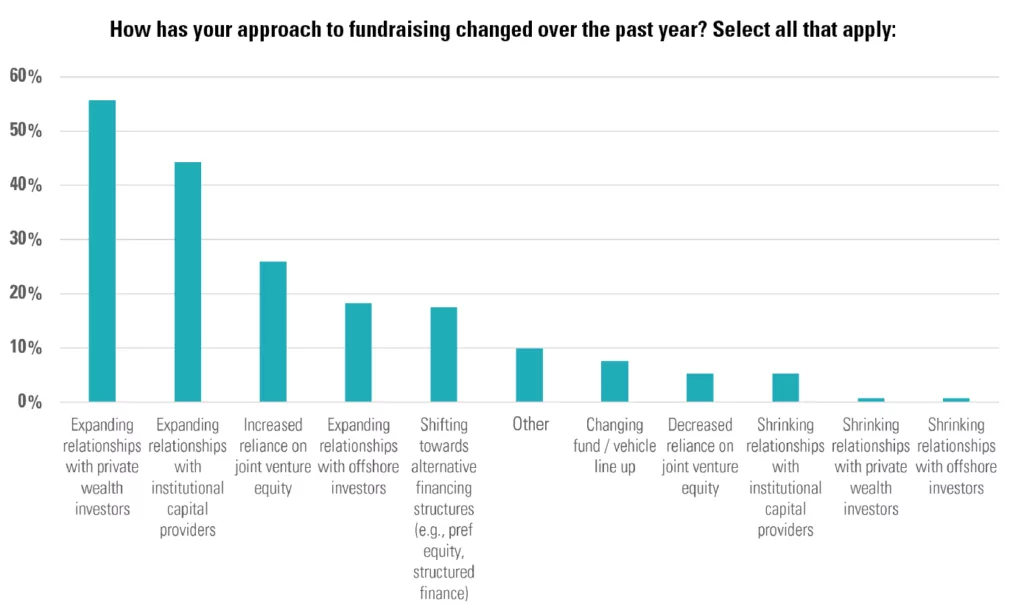
This diversification is also reflected in fundraising strategy. More than half of respondents report actively expanding relationships with private wealth investors, while nearly half are simultaneously deepening institutional partnerships. Offshore capital has also emerged as a more prominent source of investment capital, suggesting firms are casting a wider net as fundraising conditions gradually improve.
Across responses, executives appear focused on building broader and more resilient capital networks capable of supporting future growth across multiple market cycles.
Ownership & Strategic Growth
Interest in mergers and acquisitions has moderated considerably over the past year, while bringing in new external investors remains the industry’s preferred avenue for funding future growth.
Compared with last year’s survey, executives report significantly less interest in pursuing mergers and acquisitions. Nearly two-thirds of respondents indicated they had not considered an acquisition over the past year, up from just under half in the prior survey. Only 10% are actively exploring transactions, while very few have completed an acquisition, suggesting that inorganic growth has become a lower strategic priority as market conditions stabilize.

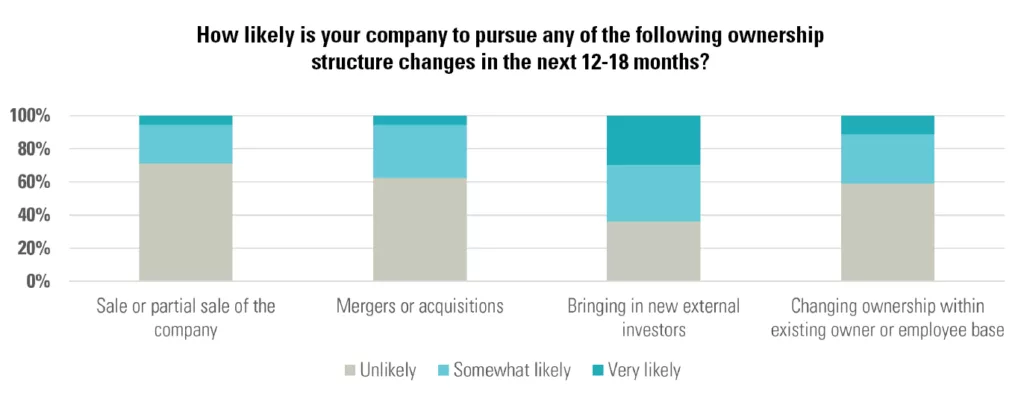
Looking ahead, respondents remain selective about broader ownership changes. More than half of firms are unlikely to pursue either a sale of the company or a merger over the next 12 to 18 months. By contrast, bringing in new external investors continues to receive the strongest support of any ownership strategy change, with nearly 60% of respondents reporting they are somewhat or very likely to pursue new capital partners. Interest in changing ownership within the existing employee or investor base is more mixed, with approximately one-third expressing some likelihood of internal ownership changes.
Technology & AI
AI adoption continues to accelerate across the industry, with firms shifting from experimentation toward operational deployment while focusing primarily on employee productivity and work quality rather than workforce reduction.
In RCLCO’s AI strategy and governance work and in conversations with clients across the industry, an early but recurring theme is that the firms getting real value from AI are distinguished less by high technology spend than by data readiness and organizational ownership. We see firms across a wide spectrum: some still at the starting line, where AI use means individual employees using general-purpose chatbots without firmwide policy or data governance; many actively piloting tools in investment screening, lease abstraction, research, and writing, but not yet establishing standard practices; and a smaller group with dedicated data science staff, centralized property and transaction data, intentionally developed innovation infrastructure, and governance frameworks.
Among survey participants, only 3% of respondents report no meaningful use of AI today, while nearly half remain in the experimentation phase. More cautious firms are waiting for proven use cases before making significant AI investments. Said one diversified investment manager senior leader, “We’re focused on AI but haven’t solved it yet—I don’t want to throw a bunch of money at it without a proof of concept.” At the same time, almost one-quarter have progressed to department-level or enterprise-wide deployment. Larger firms appear to be leading this transition, with approximately one-third reporting firmwide AI deployment compared with only 14% of smaller organizations.

Notably, AI is not primarily a cost story. Firms overwhelmingly cite increasing employee productivity (85%) and improving work quality (71%) as their objectives, with reducing operating costs, improving investment decision-making, and maintaining competitive positioning ranking meaningfully lower. Relatively few organizations are pursuing AI to launch entirely new products or business lines. That theme carries through to workforce expectations.

Only 15% anticipate workforce reductions, although that expectation rises among larger organizations where AI is becoming more deeply integrated into business processes. Collectively, the results suggest executives increasingly view AI as a tool for scaling organizational capacity and improving efficiency rather than materially shrinking their workforce.
Ultimately, executives view AI as a complement, not a substitute, for the industry’s human-centered nature. As one executive remarked, “People want a narrative. We’re in the business of telling stories, and the bigger the dollars, the more they want a compelling story.” Consistent with respondents’ emphasis on productivity over workforce reduction, the findings suggest firms expect AI to enhance human capabilities rather than replace them. In commercial real estate, competitive advantage will continue to depend on judgment, relationships, and the ability to communicate a compelling investment story.
When asked where technology is having the greatest effect, property management ranks as the most impacted area, followed closely by accounting/finance, underwriting, investor reporting, and leasing. Human resources sits at the bottom of the list, underscoring that automation and data analytics are concentrating first where they can directly enhance revenue generation, risk management, and asset performance. This pattern may suggest that early adoption is focused on more repetitive, process-driven tasks, often those that are customer-facing or transactional, rather than functions tied to major strategic investment decisions.
About RCLCO’s CRE C-Suite Survey:
In its second year, the CRE C-Suite Survey is RCLCO’s annual pulse check on the commercial real estate industry, taken from the vantage point of the executive team. It asks leaders both to assess the year behind them and to signal what they expect from the year ahead, spanning operating performance, talent, capital markets, ownership strategy, and technology. The 2026 edition drew 156 responses from C-suite and senior executives at firms ranging in size (median AUM: $3B) and spanning product types and U.S. markets. Results were supplemented by a series of follow-up conversations with select respondents.
Continue the Conversation
RCLCO Management Consulting partners with owners, developers, and investors to translate market intelligence into actionable strategy. If you’d like to discuss these findings in the context of your own portfolio or strategy:
Stay Informed:
- Follow RCLCO on LinkedIn and subscribe to our newsletter for ongoing research and market commentary.
Explore More:
- Visit our website to see examples of how our advisory team helps clients navigate capital markets, organizational transformations, and strategic planning.
Disclaimer: Reasonable efforts have been made to ensure that the data contained in this Advisory reflect accurate and timely information, and the data is believed to be reliable and comprehensive. The Advisory is based on estimates, assumptions, and other information developed by RCLCO from its independent research effort and general knowledge of the industry. This Advisory contains opinions that represent our view of reasonable expectations at this particular time, but our opinions are not offered as predictions or assurances that particular events will occur.
Copyright © 2026 RCLCO. All rights reserved. RCLCO and The Best Minds in Real Estate are trademarks of Robert Charles Lesser & Co. All other company and product names may be trademarks of the respective companies with which they are associated.