

July 1, 2026
By Lucy Bertsch, Managing Director; Isaac Gershberg, Associate; Kelsey Padgham, Principal
Strong governance is a hallmark of institutional-quality platforms, and it is increasingly relevant for private real estate firms as they scale and evolve. As organizations diversify their strategy, broaden their investor base, or face leadership transitions, governance often moves from the background to the forefront. Establishing a Board of Directors is one way to enhance governance and can serve as a powerful mechanism to align stakeholders, sharpen decision-making, provide accountability, and guide long-term strategy.
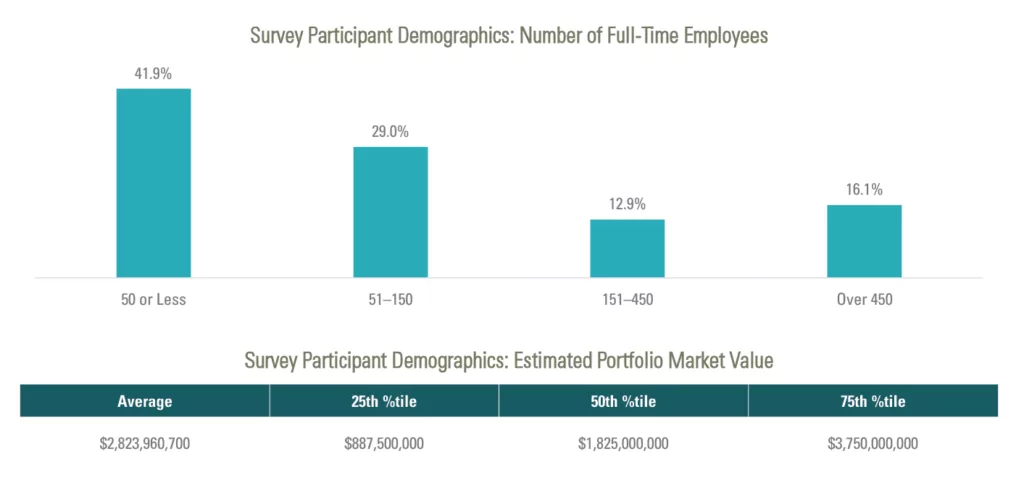
To better understand how real estate firms, particularly privately held companies, are approaching board composition, RCLCO’s Compensation Consulting practice conducted its inaugural Board of Directors Compensation Survey, capturing market practices across 30+ companies spanning asset classes, geographies, and service offerings. The survey examined a range of topics, including board composition and structure, director compensation, committee responsibilities, meeting practices, and other elements of board governance and administration. The respondent pool was primarily comprised of privately held and family-owned organizations, with participants operating across regions throughout the United States.
The Role of a Board
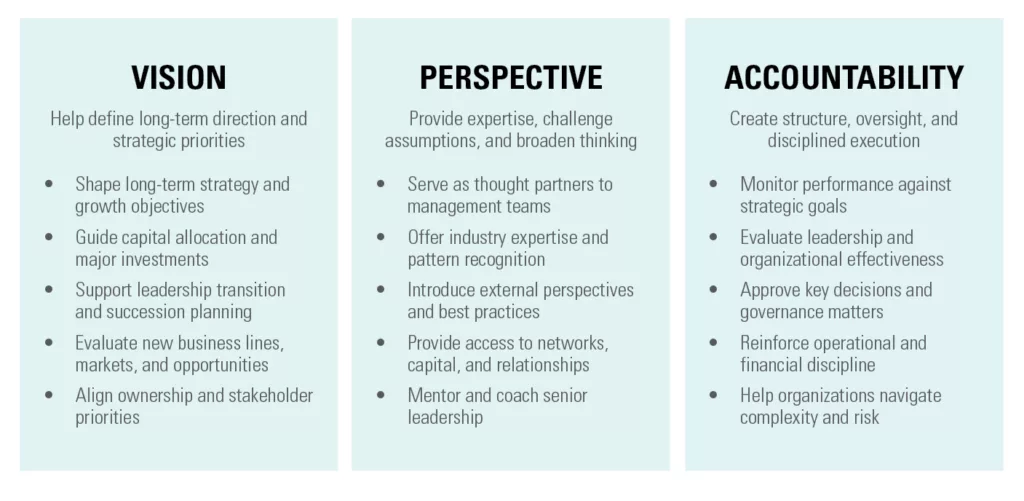
At their core, boards serve three primary functions: they help define vision, provide perspective, and create accountability. While boards do not operate the business day-to-day, effective boards shape the decisions that matter most, from capital allocation and major investments to leadership transitions. Just as importantly, boards can serve as valuable thought partners to CEOs and senior leadership teams, offering constructive challenge, and, in many cases, a form of mentorship or coaching.
Board Composition
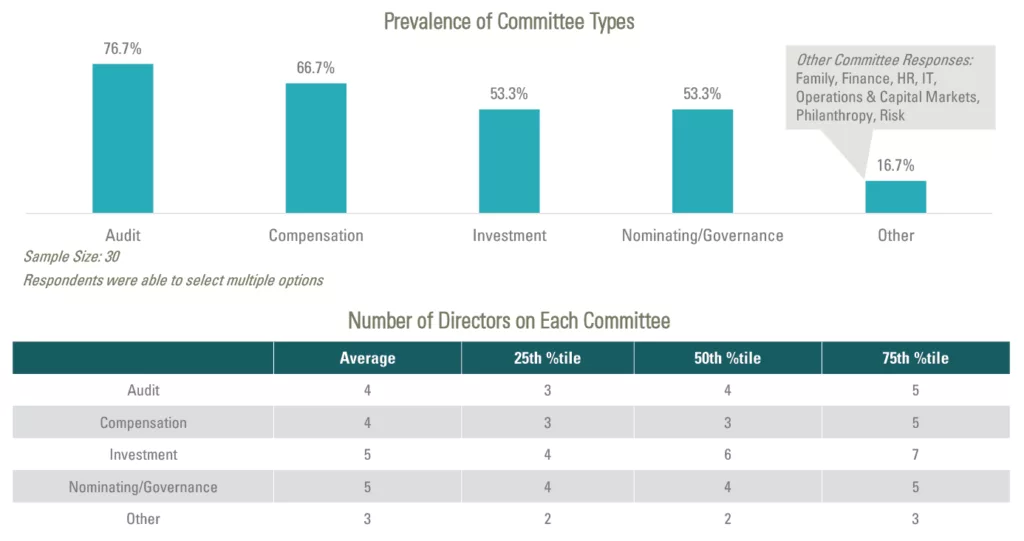
According to surveyed companies, the typical private real estate board consists of approximately seven directors, meets on a quarterly basis (with 76.7% of surveyed companies reporting in-person board meetings), and operates through a set of standing committees focused on areas such as audit, compensation, nomination/governance, and investment.
If boards are a strategic tool, their composition must reflect the firm’s priorities. Most private boards include a mix of internal leadership and external directors. Senior executives often sit on the board, providing operational context and continuity, while external members bring complementary skills and perspectives. Nearly three-quarters (74.2%) of surveyed firms include employees on their boards, highlighting the importance of maintaining a close connection between governance and operations.
In family-owned businesses, board composition often serves the additional purpose of maintaining alignment across generations and ownership groups. Family representation on a board can reinforce continuity of vision and values, but it also introduces the need for balance. Independent directors play a critical role in that balance, bringing objectivity and helping to mediate between different stakeholder perspectives.
Firms tend to select external directors for the perspectives, functional expertise, and pattern recognition they can bring to the organization. In practice, many boards are intentionally assembled across complementary skillsets. Common director profiles include legal professionals with governance and regulatory experience, finance or accounting leaders (often CPAs or former public accounting partners), HR and talent executives, experienced operators, and long-time industry veterans with deep market relationships. At the same time, many firms also seek directors from outside the real estate industry to introduce differentiated perspectives from adjacent sectors or broader corporate leadership experience.
Beyond functional expertise, firms are increasingly thinking about board composition through a generational lens. Unsurprisingly, there is meaningful board member representation from senior leaders who have exited full-time operating careers, as the retirement of a large cohort of baby boomer executives has created a strong talent pool for director opportunities. At the same time, some firms are incorporating younger generations into governance structures in order to bring different perspectives, enhance risk oversight, and improve innovation.
Boards in Practice: Common Governance Archetypes
While no two boards are structured exactly alike, several common governance archetypes emerge across private real estate firms.
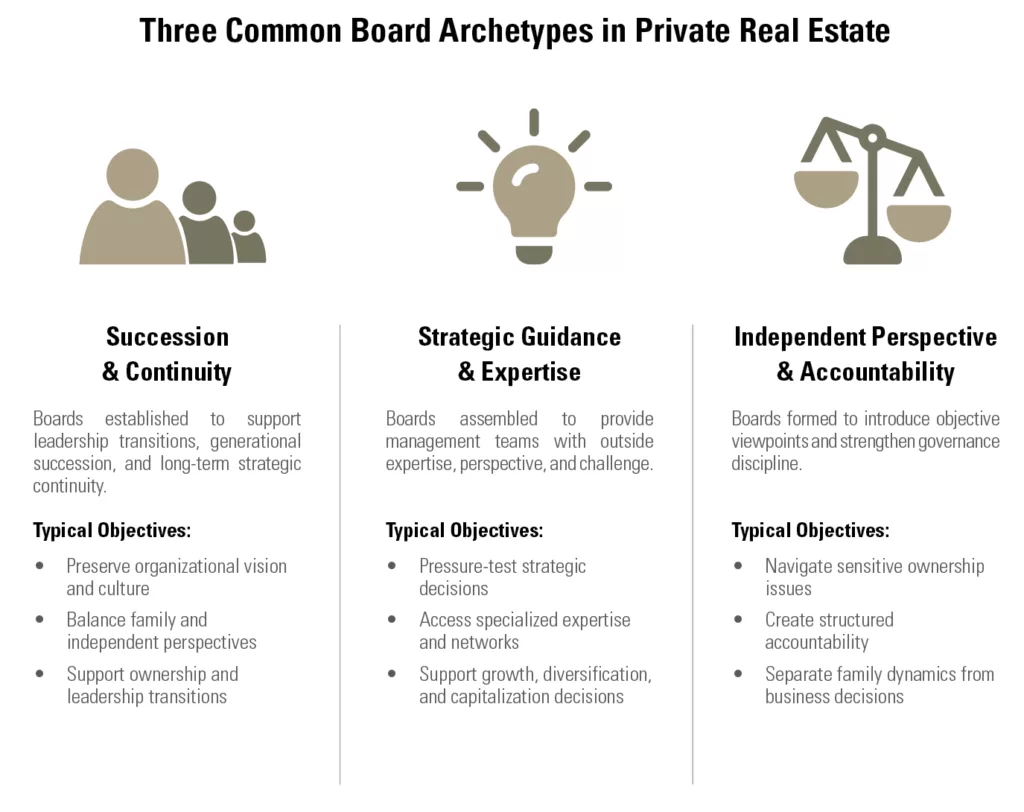
One common driver of board formation is succession planning and leadership transition. In multigenerational family-owned businesses, boards are often formalized to help preserve strategic continuity as leadership transitions from founders to the next generation. These boards frequently combine family representation with independent directors who can provide institutional knowledge, objective guidance, and broader operating experience. In many cases, external board members are intentionally selected from complementary backgrounds to help navigate evolving ownership participation.
A second archetype is the establishment of boards to provide strategic guidance and perspective. These boards are often less focused on formal oversight and more focused on providing management teams with access to outside expertise. Companies pursuing growth, diversification, recapitalization, or operational evolution may assemble advisory-oriented boards composed of professionals with backgrounds in investment management, capital markets, construction, legal, or broader corporate leadership. In these cases, boards act as strategic thought partners to leadership teams, helping organizations pressure-test ideas, evaluate opportunities, and benefit from perspectives developed outside the company.
A third common model is the family-owned company seeking independent perspective and accountability. In these situations, boards are often established to introduce objective viewpoints outside of the ownership group, particularly as organizations become larger or more operationally complex. Independent directors can help families navigate sensitive issues such as compensation, governance, leadership development, and long-term strategic prioritization while creating a more structured forum for discussion and accountability. For many family-owned firms, boards also provide a mechanism to separate family dynamics from business decision-making and reinforce institutional discipline over time.
Taken together, these examples reinforce an important theme: there is no singular “correct” board structure. Effective governance frameworks are highly dependent on a firm’s ownership dynamics, strategic objectives, and stage of growth.
Compensation
For firms considering whether to introduce a board, governance is not costless. Across surveyed firms, the majority (73.3%) provide annual retainers to board members, with many also offering meeting fees (43.3%) and equity or long-term incentives (30.0%). Among those offering long-term incentives, promote/carried interest is the most common structure, alongside restricted stock units and deferred compensation plans, with fewer firms utilizing stock options or performance-based equity.
Beyond direct compensation, board roles often include additional benefits. A meaningful percentage of participants (41.7%) offer co-investment opportunities, further aligning directors with the firm’s investment strategy. Median total compensation is approximately $74,000 for board members and $120,000 for chairpersons, underscoring both the time commitment and the level of accountability expected. These structures increasingly position board members as partners in long-term value creation.
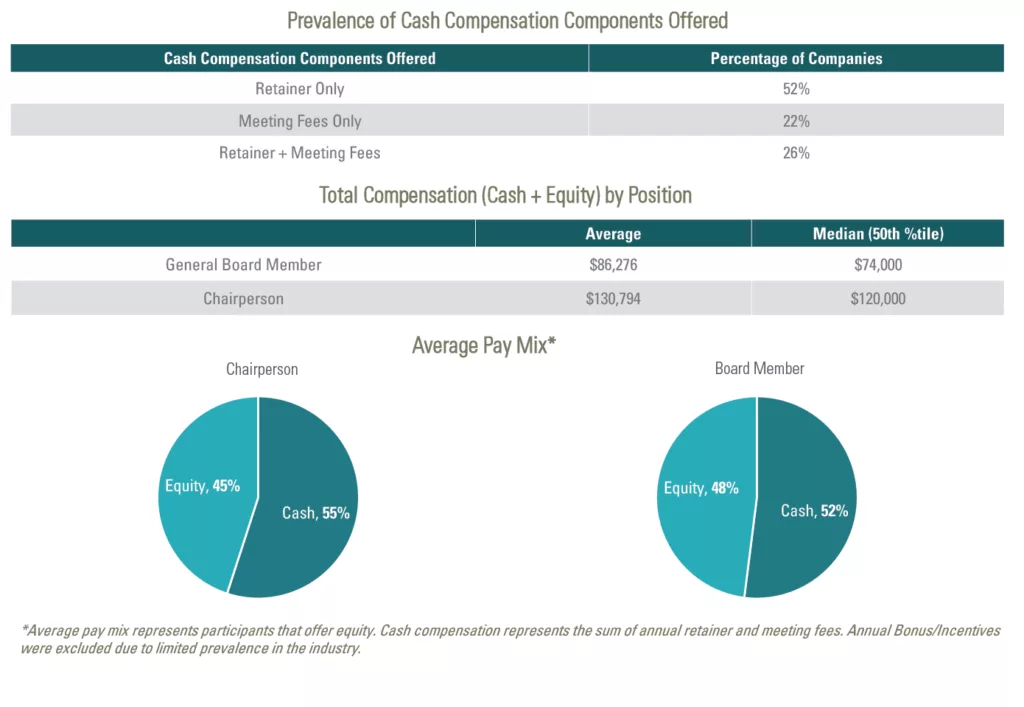
Compensation structures increasingly align board members with the firm’s long-term performance. The prevalence of equity participation and co-investment opportunities signals a shift toward treating board members as advisors and as partners in value creation. While costly, when designed effectively, board governance can generate returns through better decisions, stronger alignment, and reduced execution risk.
Closing
And as private real estate firms continue to scale and institutionalize, governance can be a differentiator. Firms with well-structured boards may be better positioned to navigate leadership transitions, attract institutional capital, and maintain discipline in their investment strategies. They are able to balance competing priorities, incorporate external perspectives, and make decisions with greater clarity and consistency.
This does not mean that every firm needs a board today, but it does suggest that governance should be treated as a deliberate component of strategy. The firms that think proactively about governance, rather than reactively, are often better equipped to manage growth and uncertainty. Ultimately, the effectiveness of a board depends on how it is designed. Structure, composition, and process all matter, and there is no single model that fits every organization.
For organizations considering whether a board is the right structure to support long-term ambitions or looking to evolve an existing board to better align with future goals, RCLCO advises firms on the design of governance frameworks and related compensation programs tailored to their strategic objectives and stage of growth. To learn more about how RCLCO can support your organization, please reach out to our team:
Joshua A. Boren
Managing Director, Strategic Initiatives