July 30, 2026
In Summary
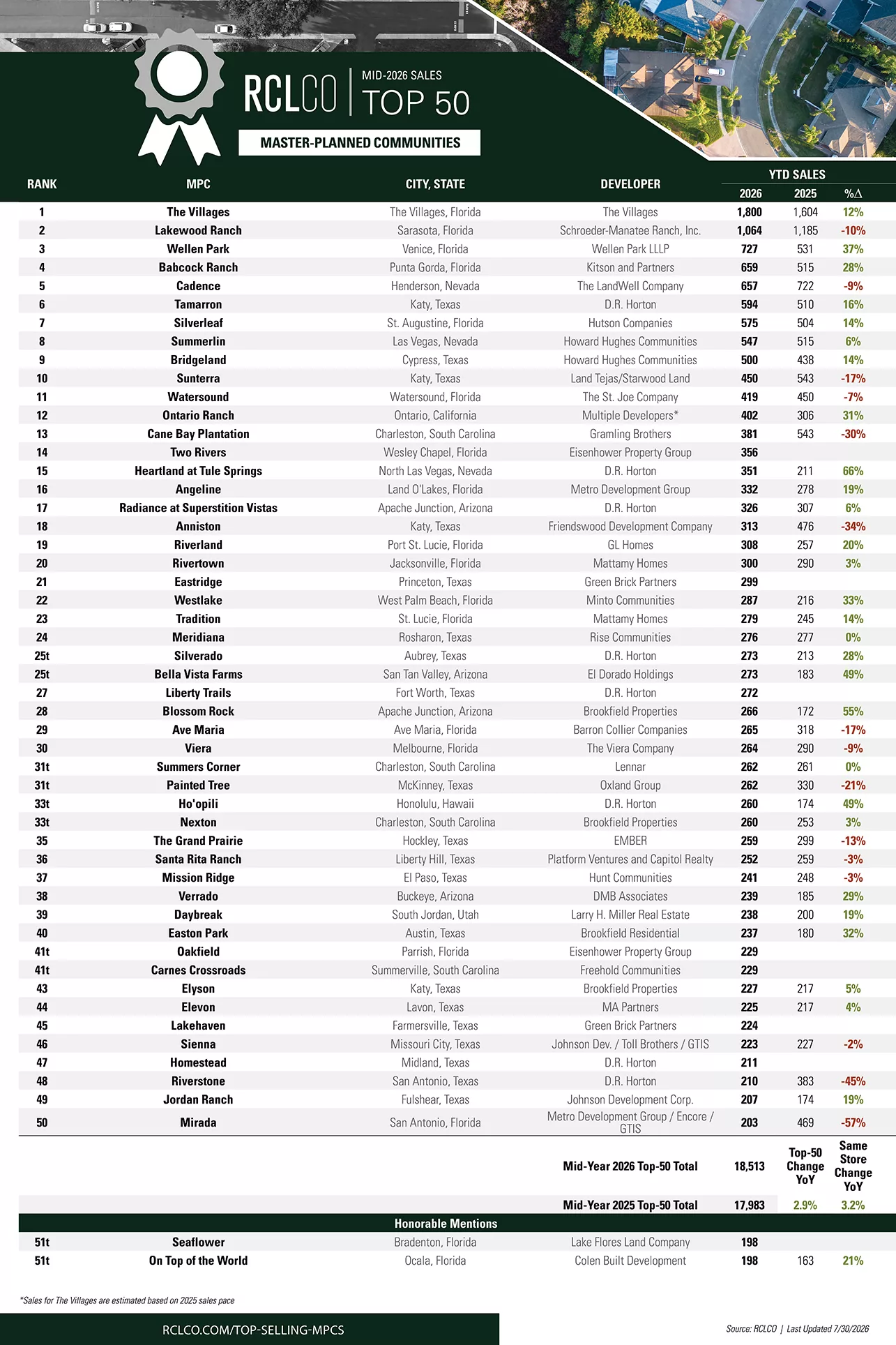
- New home sales among the 50 Top-Selling Master-Planned Communities rose nearly 3% in the first half of 2026 compared to the same period last year, a strong outperformance relative to the national home market.
- Economic uncertainty, weak consumer sentiment, and continued affordability challenges are contributing to a slower new home market, with new home sales nationally declining 5.6% YoY in June.
- The Villages is once again estimated to remain the top-selling community in the nation as it continues to attract retiree buyers to Central Florida.
- Sarasota, Florida’s Lakewood Ranch claims the number two spot overall with 1,064 sales and remains the top-selling multigenerational community in the country through the first half of the year.
- In addition to Sarasota, Southwest Florida continues to impact the rankings, with Venice, Florida’s Wellen Park earning the third-place rank with 727 sales through the mid-year, and Punta Gorda, Florida’s Babcock Ranch coming in fourth place with 659 sales. Both communities saw significant outperformance compared to last year, with homes sales increasing by 37% and 28%, respectively.
- The Houston MSA is once again the top-performing metropolitan area with 9 communities in the Top 50, representing 3,049 sales, or 16% of all sales among ranked MPCs.
- The state of Florida represents 44% of sales among ranked communities, followed by Texas at 31%
Every year since 1994, RCLCO has conducted a national survey identifying top-selling master-planned communities (MPCs) through a rigorous search for high-performing communities in each state. This initiative, now in its third decade, exists not only to recognize the most successful communities in the country, but also as a tool for monitoring the overall health of the for-sale housing industry, and a means of highlighting the trends affecting communities large and small. This process also serves as a mechanism through which to learn development best practices and pass along lessons gleaned from the MPCs that have pioneered their way into the top ranks. That information contributes to the knowledge base utilized in RCLCO’s MPC consulting practice. Each year we report the annual sales among the Top-50 communities at the end of the year, as well as publish this mid-year update in July. For this 2026 Mid-Year report, we have surveyed MPCs throughout the country to establish the current rankings following our The Top-Selling Master-Planned Communities of 2025 published in January 2026.
Overall, sales among the Top 50 rose approximately 2.9% year-over-year, a meaningful contrast to the broader new home market, which saw national new home sales decline 5.6% YoY in June 2026. Same-store sales, which track only communities with comparable data from the prior year, showed a similarly healthy increase of about 3.2%.
Top-Selling Master-Planned Communities of 2026: Mid-Year Update
The U.S. new home market has faced a challenging environment through the first half of 2026. Mortgage rates have hovered near 6.5%, providing only modest relief from the peaks of 2023 and 2024. Consumer confidence, as measured by the University of Michigan’s index, hit a June low of 49.5, and improved only slightly to 54.4 in July, well below its long-run average of 84. This consumer uncertainty partly reflects elevated energy prices, (up 15.7% year-over-year), and broader economic uncertainty tied in part to global political concerns including the Iran conflict. Against this backdrop, national new home sales declined 5.6% year-over-year in June 2026.
That makes the performance of top-ranked MPCs all the more notable. Despite these headwinds, total sales among the Top 50 reached 18,513 through mid-year 2026, up from 17,983 in the same period last year. This trend aligns with a long-standing pattern RCLCO has tracked since the years following the Great Financial Crisis: consumers seek safety and lifestyle value in master-planned community environments, trusting that their investment is protected by the place-making, amenity depth, and product diversity that top developers deliver.
The Villages in Central Florida is once again the top-selling community in the nation, with an estimated 1,800 sales through mid-year. Known as the largest active adult community in the United States, The Villages continues to attract retiree buyers from across the country. Sarasota, Florida’s Lakewood Ranch holds the second position with 1,064 sales, making it the top-selling multigenerational community in the country.
Wellen Park in Venice, Florida earned the third-place rank nationally with 727 sales, a remarkable 37% increase over its mid-2025 pace. Babcock Ranch in Punta Gorda earned fourth place with 659 sales, building on a 28% year-over-year increase. Babcock Ranch’s continued ascent, building from its resilience story following Hurricane Ian and its distinctive sustainability focus, presents one of the most compelling master-planned community development stories in the country.
Cadence in Henderson, Nevada rounded out the top five at fifth place with 657 sales, reflecting continued strength in the Las Vegas MSA, where the three ranked communities (Cadence, Summerlin, and Heartland at Tule Springs) together contributed 1,555 sales through mid-year.
The Houston MSA once again leads all metropolitan areas with 9 communities in the Top 50, contributing 3,049 sales through mid-year, or approximately 16% of all sales among ranked communities. The Dallas-Fort Worth MSA placed 6 communities in the Top 50 for 1,555 in combined sales, while Charleston, Tampa, and Phoenix each produced 4 ranked communities representing about 6% of Top-50 sales each.
From a state perspective, Florida represented approximately 44% of all sales among ranked communities, up slightly from 41% at mid-year 2025, with 16 communities ranked in the Top 50. Texas followed with 20 communities ranked, accounting for 31% of total sales. Together, Florida and Texas accounted for 75% of all Top-50 sales, underscoring the continued dominance of these two states in the master-planned community landscape.
MPCs as a Safe Harbor: Outperforming in an Uncertain Market
At a moment when national new home sales are down 5.6% year-over-year, the Top-50 MPCs are running nearly 3% ahead of the same period last year. That is a roughly 8-percentage-point swing in relative performance, and it reflects a pattern RCLCO first identified in the years following the Great Financial Crisis and has tracked across multiple economic cycles since. When broader market conditions deteriorate, or consumer confidence declines, buyers increasingly seek safety and value in their investments. Within master-planned community environments, they trust that the purchase they are making in a thoughtfully planned, amenity-rich community is more protected against market fluctuations than a comparable purchase in a conventional subdivision. Place-making, scale, lifestyle infrastructure, and product diversity function as a hedge against economic uncertainty.
The most discerning buyers who are cautious, who are making deliberate, research-intensive decisions about where to buy, gravitate toward communities that offer a strong value proposition beyond the home itself. Trails, parks, town centers, schools, social programming, and a sense of community are the reason buyers commit. The communities at the top of the rankings are not immune to the macro environment, with several posting year-over-year declines, but the cohort as a whole has demonstrated the cyclical resilience that has become one of the most consistent findings across 30-plus years of RCLCO’s MPC tracking.
Outlook for the Second Half of 2026 and Beyond
The macroeconomic environment for housing remains challenging, and the path to recovery is not without risk. Mortgage rates near 6.5% continue to price out meaningful segments of the market, particularly first-time buyers. Construction material costs are elevated, with the Producer Price Index for construction materials up 9% year-over-year. Job growth slowed to just 57,000 net jobs in June, though the three-month average of 111,000 remains above the 12-month average. Consumer sentiment at 54.4 remains deeply depressed, reflecting concern over energy prices, geopolitical risk, and general economic uncertainty.
The Federal Reserve’s path to its 2% inflation target is forecast to extend into 2028, limiting the near-term potential for meaningful rate relief. Both the Oxford Economics and WSJ Consensus forecasts project headline CPI moderating further from its current 3.5% trailing rate, though energy price volatility tied to the Iran conflict introduces some uncertainty to that outlook. Since hostilities resumed on July 7, with oil back above $90/barrel, this is likely to remain the biggest wildcard factor in both inflation and mortgage rate expectations.
Against this backdrop, we hold a cautiously constructive view on the MPC segment for the remainder of 2026. The structural advantages that top communities have demonstrated over multiple cycles (from amenity investment, diverse product mix, and strong placemaking), should continue to generate relative outperformance even as the broader market faces headwinds. Rate buydowns, mortgage rate locks, and closing-cost support will remain critical tools for communities seeking to capture share in a market where monthly payment sensitivity is high.
The longer-term fundamentals remain intact. Millennials and Gen Z represent a wave of housing demand only now beginning to peak, while there remains a structural undersupply of housing in many high-growth markets. Communities that continue to invest in lifestyle infrastructure, expand their attainable price-point offerings, and maintain product diversity across buyer segments are well-positioned to weather near-term uncertainty and emerge stronger.
RCLCO has produced the Top-Selling Master-Planned Community Report since 1994, making it the longest-running publication on master-planned community performance in the industry. The ranking of communities is based on total new home contracts, net of cancellations, as reported by each individual community.
To be included in RCLCO’s ranking, MPCs must have several key features. True MPCs are developed from a comprehensive plan by a master developer, and incorporate a variety of housing types, sizes, and prices, with shared common space, amenities, and a vital public realm. The best examples of MPCs are developed with a strong vision and comprehensive plan that guide development and unify the community through distinctive signage, wayfinding, entry features, landscaping, and architectural/design standards. MPCs differentiate themselves from typical suburban subdivisions in terms of scale, as well as in how they provide a means for interaction among neighbors in the sense of the word “community.” They foster an environment within which generations can live better in terms of housing and the community environment, and many MPCs also offer educational opportunities, neighborhood shopping and services, and even employment centers to complement the residential neighborhoods. Although rooted in a vision, the most resilient MPCs have flexible master plans that are environmentally sensitive, market responsive, and nurture the lifestyles of their residents.
Given the above criteria, we do not include the collective sales of multiple, separate communities that are unified only through marketing efforts rather than a preconceived community vision, nor do we include communities that are a collection of subdivisions that have few unifying elements other than name.
More on the Top-Selling Master-Planned Communities
Article and research prepared by Karl Pischke, Principal, and Gregg Logan, Managing Director. Additional research support was provided by Kimberly Asbell, Christopher Bitter, Shanren Brienen, Maggie Henderson, AJ Tenser, Alex Valdes, and Jocelyn Wang.
Disclaimer: Reasonable efforts have been made to ensure that the data contained in this Advisory reflect accurate and timely information, and the data is believed to be reliable and comprehensive. The Advisory is based on estimates, assumptions, and other information developed by RCLCO from its independent research effort and general knowledge of the industry. This Advisory contains opinions that represent our view of reasonable expectations at this particular time, but our opinions are not offered as predictions or assurances that particular events will occur.