October 22, 2026
For more than 40 years, RCLCO has advised institutional landowners and private developers across Hawaiʻi’s real estate landscape. Our work spans a range of product types and scales—from affordable and workforce housing to sports-anchored mixed-use and ultra-luxury resort communities—and includes experience on each of the inhabited Hawaiian Islands. The complexity of these assignments and our long-standing relationships have allowed us to support clients through both our Real Estate Economics and Management Consulting practices.
Last month, RCLCO Vice President Patricia Bacalao attended ULI Hawaiʻi’s Pacific Summit in Honolulu, a biennial gathering of developers, investors, architects, planners, and public-sector leaders focused on the future of Hawaiian real estate. The site tours, keynote presentations, and panel discussions echoed themes we have heard from clients and observed in our work across the market. We summarize four key themes below:
Key Themes:
- Land, community, and development are deeply interconnected: Hawaiʻi’s relationship-driven development environment places a premium on local relationships and partnerships, stakeholder alignment, and community engagement
- New development in Hawaiʻi costs more and takes longer than in comparable mainland markets, although more public financing tools may become available in the near future
- Hawaiʻi’s high housing costs have intensified the bifurcated nature of the K-Shaped economy and real estate market
- Hawaiʻi’s extensive military presence is a defining force in its land-use, housing, and development landscape, making coordinated military, public-sector, and private-sector planning essential
No.1:
Land, community, and development are deeply interconnected: Hawaiʻi’s relationship-driven development environment places a premium on local relationships and partnerships, stakeholder alignment, and community engagement
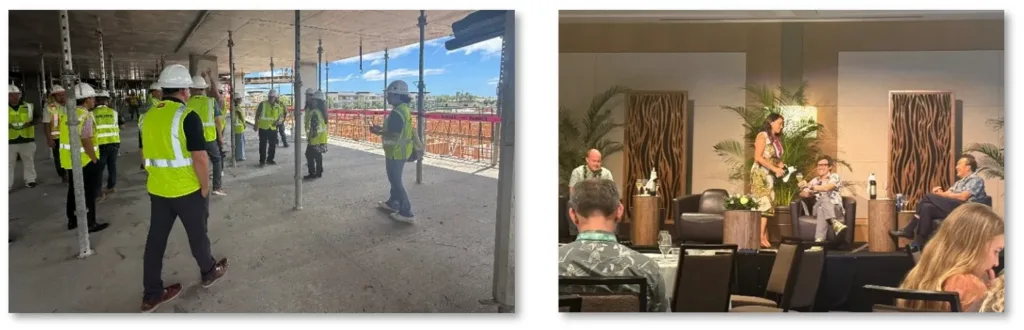
ULI Hawaiʻi Pacific Summit Tours & Panel Discussions; September 2026
Source: RCLCO
Hawaiʻi’s development community is distinguished by a deeply collaborative culture, evident in the relationships and camaraderie on display throughout the summit. In a market defined by limited developable land, complex approvals, and high delivery costs, These collaborations also reflect a shared stewardship of Hawaiʻi’s land, culture, and long-term community well-being.
Conversations with local developers and investors consistently pointed to an emphasis on collaboration over zero-sum competition. This “rising-tides” mindset appears to be an important feature of the market: it helps stakeholders navigate Hawaiʻi’s development constraints, pool expertise and capital, and retain a greater share of the economic and community benefits of growth locally. Moreover, it reflects a cultural value best exemplified by the Hawaiian principle of mālama ʻāina, meaning “ to care for the land.”
No. 2:
New development in Hawaiʻi costs more and takes longer than in comparable mainland markets, although more public financing tools may become available in the near future
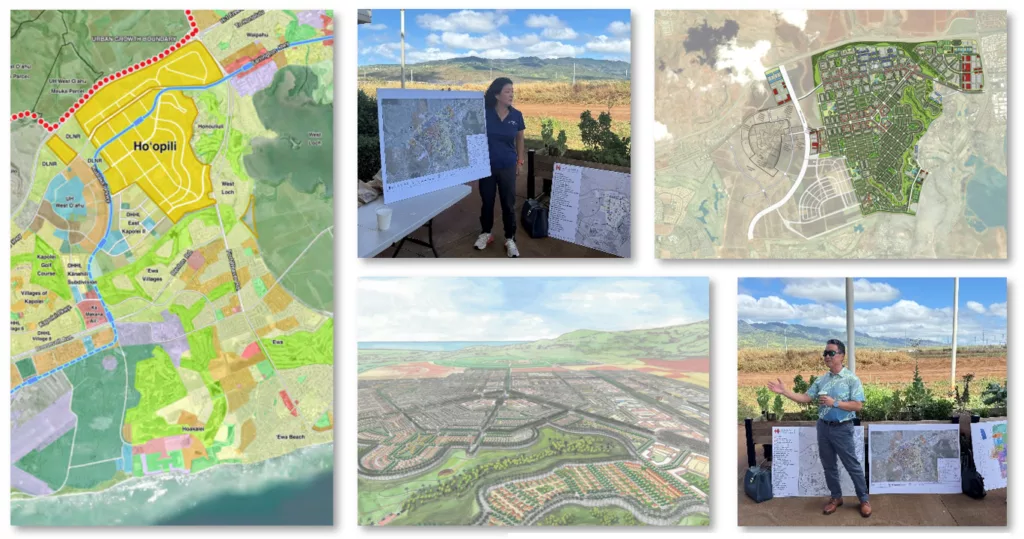
Hoʻopili Master Plan; Ewa Plain of West Oʻahu, HI
Source: D.R. Horton, RCLCO
Large-scale, master-planned development in Hawaiʻi is constrained by the substantial upfront cost of infrastructure. Construction costs are among the nation’s highest, driven by the expense of shipping materials—further elevated by the Jones Act’s U.S.-vessel requirements—and high labor costs across the islands. Public financing tools have also historically been limited. Although Hawaiʻi authorized community facilities districts (CFDs) in the 1990s, only one has been established and used: Kukuiʻula on Kauaʻi, formed in 2008.
This environment could change with Hawaiʻi Question 2, scheduled for the November 3, 2026 ballot. If approved, the constitutional amendment would authorize counties to issue Resilient Infrastructure for Shelter and Equity (RISE) bonds in designated areas, enabling tax-increment financing for public infrastructure. The tool could support infrastructure associated with new development, particularly housing.
A highlight of the Pacific Summit’s West Oʻahu housing tour, D.R. Horton’s 1,600-acre Hoʻopili master-planned community illustrates both the scale of the challenge and the long investment horizon required. Over roughly 20 years, the project has involved billions of dollars in investment in transit-oriented development, roads, trails, parks, schools, and community facilities. After a lengthy entitlement and horizontal-development process, Hoʻopili has begun to capture the value created within the community, with its first homes delivered roughly a decade ago and a substantial runway remaining to complete its planned nearly 12,000 housing units.
No. 3:
Hawaiʻi’s high housing costs have intensified the bifurcated nature of the K-Shaped economy and real estate market
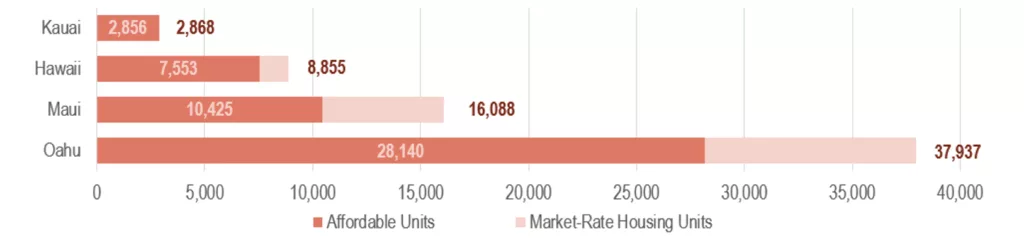
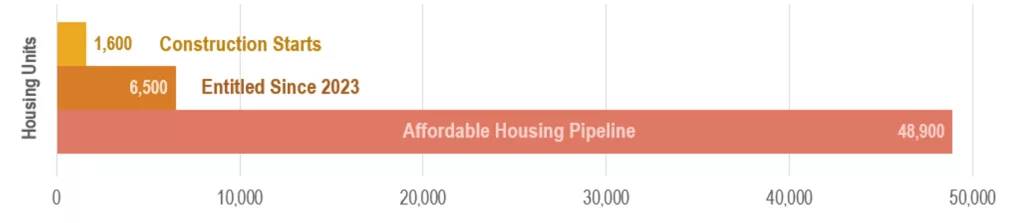
Affordable Housing Development Pipeline by Island; April 2026
HHFDC Statewide Progress; 2025
Source: HHDFC; Hawaii.gov
Development in Hawaiʻi is increasingly concentrated at the two ends of a K-shaped housing market. Ultra-luxury resort and residential projects continue to advance, supported by out-of-market demand and pricing that can accommodate high development costs. At the other end, affordable housing production has gained momentum, with the affordable-unit pipeline outpacing market-rate development, aided by state and local initiatives such as Governor Josh Green’s emergency proclamation.
Housing production across the broader market, however, remains limited by rising construction and financing costs, as well as entitlement and permitting challenges. These constraints are particularly acute for the “missing middle”: households earning too much for income-restricted housing but too little to afford prevailing market-rate homes.
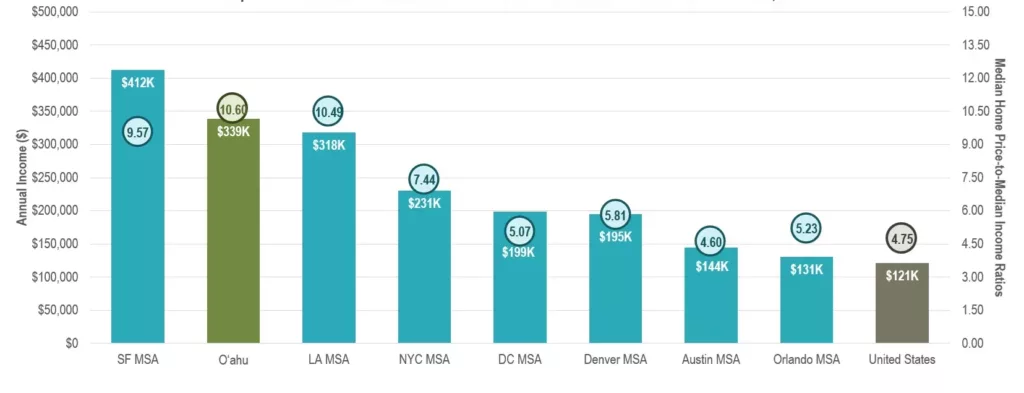
UHERO data presented at the Pacific Summit highlighted the scale of this affordability gap, including the incomes required for median-priced homes and rentals, the limited share of households meeting those thresholds, and the aging housing stock. A comparison of Oʻahu with RCLCO’s office locations found that Oʻahu’s median home price ranks second only to San Francisco, yet local incomes do not provide a comparable offset. As a result, Oʻahu has the highest home-price-to-income ratio in the set and among the highest nationally. However, some local homebuilders are pursuing smaller lots, condominium regimes, and energy-efficient designs to reduce homeownership costs for this middle segment.
Required Annual Income to Purchase Home & Median Home Price-to-Median Income Ratios; 2025
Source: Harvard Joint Center for Housing Studies; RCLCO
No. 4:
Hawaiʻi’s extensive military presence is a defining force in its land-use, housing, and development landscape, making coordinated military, public-sector, and private-sector planning essential
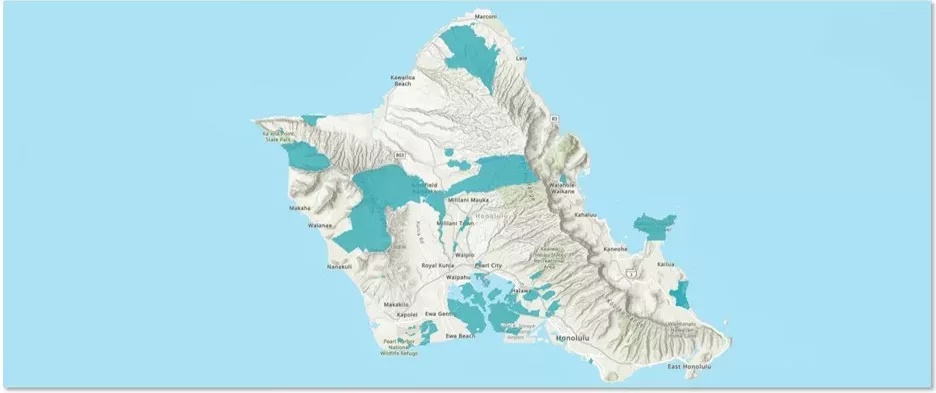
Land Controlled by the Department of Defense; Oʻahu, HI; 2026
Source: Department of Defense
Most Pacific Summit sessions focused on macro-level forces shaping Hawaiʻi’s real estate environment rather than individual property sectors. A keynote by Loren A. Johnson of U.S. Indo-Pacific Command (INDOPACOM) highlighted Hawaiʻi’s strategic role in U.S. military operations and the reciprocal influence of the military on the state’s land use and development patterns.
Hawaiʻi has the nation’s highest per-capita concentration of military personnel and ranks among the top ten states by total active-duty and reserve personnel, a notable position for a state with a population of approximately 1.48 million. The Department of Defense estimates that its holdings encompass roughly 25% of Oʻahu’s land area and 5% of land statewide, among the largest shares nationally.
This extensive land footprint affects the location, scale, and timing of development opportunities, particularly where military properties may be decommissioned or transitioned to civilian use. Given the relationship among military landholdings, the local workforce, and private development, coordinated planning among military stakeholders, public agencies, and the private sector will remain important as Hawaiʻi plans for future community growth.