
November 5, 2026
In Summary:
- Many characteristics of American retirement communities that we think of as part of today’s “active adult retirement community” scene grew out of traditions that started much earlier in the 20th century, especially in Florida and Arizona. These include attainably priced housing, fostering a sense of community and belonging through recreation and social venues, and clubs and activities managed by professional staff.
- The active adult community has evolved considerably in its housing products, pricing, amenities, and target markets, but the fundamental motivations for choosing this lifestyle have proved more enduring than generational preference surveys have sometimes suggested.
- Florida’s active adult market grew out of nearly a century of relatively affordable retiree housing development, starting with installment-plan lots, retiree-oriented trailer parks, condominiums and manufactured homes. It has since evolved into a segmented, branded, amenity-rich market with new-home prices from the high $300Ks to $1M+.
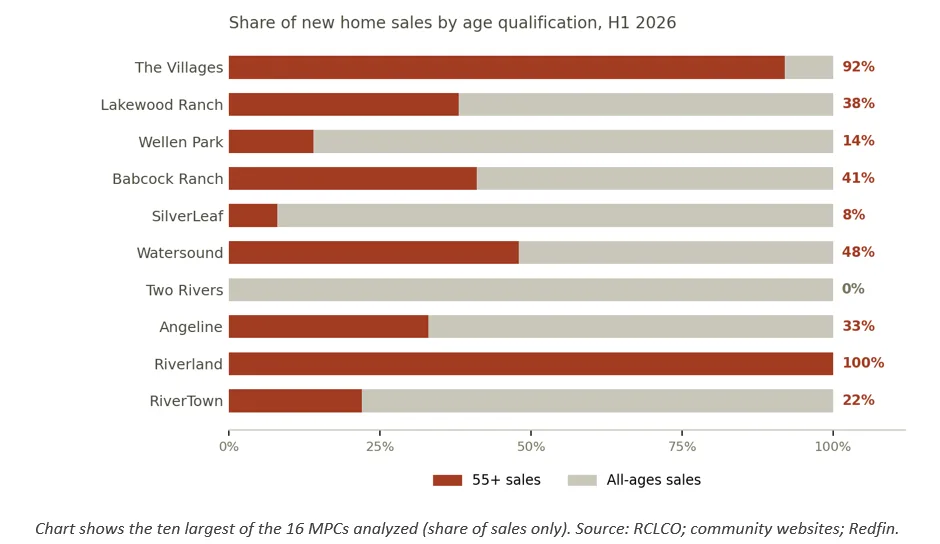
- Today’s age-qualified communities are largely enclaves inside master-planned communities (MPCs). In the first half of 2026, 44% of new home sales in Florida’s top 16 MPCs were 55+ (3,509 of 8,067), or 26% excluding The Villages and Riverland. Today the 13 major builder/developer 55+ brands active in Florida build inside MPCs; while five also build stand-alone 55+ communities.
- The market is now broadening in both directions: legacy active adult communities are adding all-ages neighborhoods, and builder/developers are extending lifestyle brands without age qualification, e.g. Del Webb Explore and Taylor Morrison’s non-age-qualified Esplanade communities.
Introduction
Although Del Webb built one of the first large-scale retirement communities in the U.S. in Arizona, Florida has long since become the heart of the nation’s active adult market, with 4.9 million age 65+ residents (compared to 1.4 million in Arizona). Sumter County, Florida, home of The Villages retirement community, has the highest share of residents aged 65+ in the U.S. at about 60%. Other Florida counties with huge shares of age 65+ population include Charlotte (43%), Citrus (39%) and Highlands (37%) counties. Historically, each of these oldest counties was marketed to Northeastern and Midwestern retirees through mail-order campaigns, department-store displays and celebrity pitchmen.
This Advisory traces how Florida’s active adult communities (AACs) evolved from affordable retirement housing into today’s highly segmented, upper-middle-market lifestyle brands. They serve as a proxy for where this product segment is headed, including an emerging sub-segment, a newer generation of resort-style communities that offer the active adult lifestyle without an age restriction.
The evolution of Florida’s retirement communities raises important questions about the future of the market. For example, as Generation X approaches retirement, will its housing and lifestyle preferences differ fundamentally from those of previous generations, or will many of the same motivations that attracted the Silent Generation and Baby Boomers to active adult communities continue to shape demand? The emergence of non-age-qualified lifestyle communities suggests that the traditional active adult development model appeals to a broader audience. But understanding the potential of these new products requires distinguishing between generational preferences and the changing priorities of households as they approach and enter the retirement lifestage.
An Affordable Beginning
Early Florida retiree development was built on affordability. Installment-plan land sales (“$10-down” lots) at places like Port Charlotte drew retirees to Florida, but they lacked the organized recreation and social amenities of later communities. Later, retiree oriented trailer parks in Bradenton and Clearwater paired low-cost living with shuffleboard and organized social activities managed by a professional staff. H. Irwin Levy’s Century Village in Southeast Florida turned affordable condominiums into a retirement lifestyle through clubhouses, organized activities and entertainment. In Lake County, manufactured-home communities such as Mid Florida Lakes and Orange Blossom Gardens (which eventually became The Villages), followed the same affordability logic.
The template for the modern age-restricted community came from Arizona. Inspired by Youngtown (1954), Del Webb opened Sun City Arizona in 1960, with recreation, social clubs and shopping available early in the life of the development. Roughly 100,000 visitors came to opening weekend against 10,000 expected, and Sun City went on to sell more than 3,000 homes a year.
Del Webb Brought the Arizona Template to Florida – and Stumbled
Webb’s formula did not initially travel well. In Florida (and California), the company largely copied Arizona’s designs with few local adjustments and favored very large, remote land holdings. Sun City Center, Florida’s first large-scale, purpose-built active adult community with amenities in place, grew more slowly than expected in the 1960s. Its remote location and confusion with the existing Sun City community did not help. Webb subsequently sold the development to a Tampa real estate consortium and exited the state.
Del Webb returned in 1998 with the acquisition of the established Spruce Creek communities and has since expanded under PulteGroup, largely within existing MPCs.
Florida Entrepreneurs Created the Market
Florida’s AAC market was ultimately built by local family developers who took a patient, lifestyle-first approach.
- Colen family – On Top of the World. Sidney Colen began building for Florida retirees in 1947, and his Clearview Oaks (1958) was one of Florida’s first condominium communities built for seniors, predating Sun City, Arizona. On Top of the World in Clearwater (1967–1999) eventually delivered 4,966 condominiums to roughly 10,000 residents. In 1975 the family bought a 12,900-acre ranch near Ocala, opened a recreation center and golf course in 1982, shifted to single-family homes in 1996, and now has about 17,000 residents, with parts of the ranch still working cattle land.
- Schwartz/Morse – The Villages. The Villages began in 1972 as age-restricted manufactured housing; a 1968 federal law had forced founder Harold Schwartz to halt his mail-order lot business. Gary Morse joined in 1983 and added Del Webb-style amenities – pools, tennis, golf and bocce by 1985 and a grocery by 1987. The community switched to single-family homes in 1990 and was renamed The Villages in 1992 with a branding campaign. It sold 73 homes in 1983 and 548 in 1992, topped 1,000 sales in 1997, peaked at 4,264 in 2005, and sold 3,611 in 2025.
- Irwin Levy – Century Village. Levy proved that an affordable condominium could be sold by selling the lifestyle first, with the home essentially serving as the ticket. A 1974 Century Village advertisement offered new Deerfield Beach condominiums from $15,390 (roughly $100,000 in today’s dollars) as “The Price of Admission,” highlighting a clubhouse covering more than three acres under one roof and activities programmed and supervised by a professional staff. Levy built four Century Villages (West Palm Beach, Boca Raton, Deerfield Beach and Pembroke Pines) plus Wynmoor Village, and his company, Cenvill, became the largest condominium builder in the U.S., with more than 37,000 homes. Century Village East in Deerfield Beach alone has about 8,500 units on 800 acres.
Three lessons emerge. First, the big winners targeted middle-income retirees. Second, they marketed and delivered on the lifestyle promise up front: clubhouses, recreation, golf and commercial centers, and lifestyle drove volume. Adding commercial facilities and then commercial town centers had a huge impact on sales volume. Third, being first did not guarantee success: Del Webb created the template, but Florida’s local developers were the ones who initially succeeded in the market.
Federal Laws Influenced Success
Federal laws influenced how these communities were positioned and marketed. The 1988 Fair Housing Amendments Act prohibited housing discrimination against families with children while exempting qualifying senior housing. The 1995 Housing for Older Persons Act (HOPA) simplified the exemption: communities must still have at least one resident aged 55+ in 80% of occupied homes, but were no longer required to provide special senior facilities and services (but had to verify residents’ ages). The rules matter today because they define the line between age-qualified (AQ) and all-ages communities.
As the Buyer Changed, the Product Moved Upscale
Lifestyle has always been the product, but the buyer, the price and the amenity package have all “moved up” with prices moving up well beyond inflation would imply.
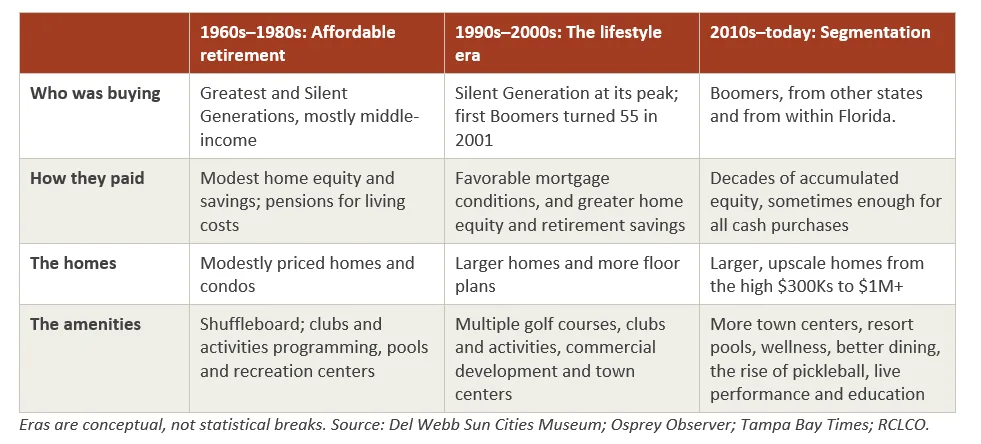
Today’s buyers tend to be well-off, healthy and equity-rich. According to NAR’s 2025 generational survey, Baby Boomers account for 42% of U.S. homebuyers, and a substantial share of Boomer buyers paid all cash. A 2024 Private Communities Registry survey of lifestyle-community shoppers (a self-selected sample) found 52% budget $500K or more and 60% plan to skip a mortgage. Equity comes from two sources. Among people moving to Florida from other states, more than half are homeowners, often having sold a home in a higher-cost state such as New York and New Jersey. At the same time, long-time Florida owners, particularly in Southeast Florida, have accumulated substantial equity since 2009, so a $500K–$800K active adult home can be a move-over or move-down purchase.
The price points reflect this shift. New homes at On Top of the World in Ocala start at about $365,000, while the top prices at Del Webb Catalina in Lakewood Ranch exceed $1 million.
Social and recreational amenities have similarly evolved. In 1950, the signature amenity was shuffleboard at a Clearwater trailer park. Today’s Esplanade at Lakewood Ranch offers heated resort-style pools with poolside bar service, a wellness center with spa, restaurants and a culinary center, eight pickleball courts, six tennis courts, four bocce courts, a dog park and an 18-hole golf course. The Villages’ five town centers, each about 500,000 square feet, anchor an offering that includes a 1,000-seat performing arts center, a lifelong learning college and more than 3,500 clubs.
Today’s Market: Active Adult Inside the MPC
One of the clearest changes in Florida is where active adult communities are built. Most Florida top selling MPCs now include AAC enclaves, and age-qualified sales are a meaningful share of their total annual sales. In the first half of 2026, about 44% of new home sales in Florida’s top 16 MPCs were age-qualified (3,509 of 8,067). Because The Villages (92%) and Riverland (100%) are almost entirely 55+, the figure falls to 26% excluding those two, meaning that in a typical top-selling Florida MPC, roughly a quarter of sales are in age-qualified neighborhoods.
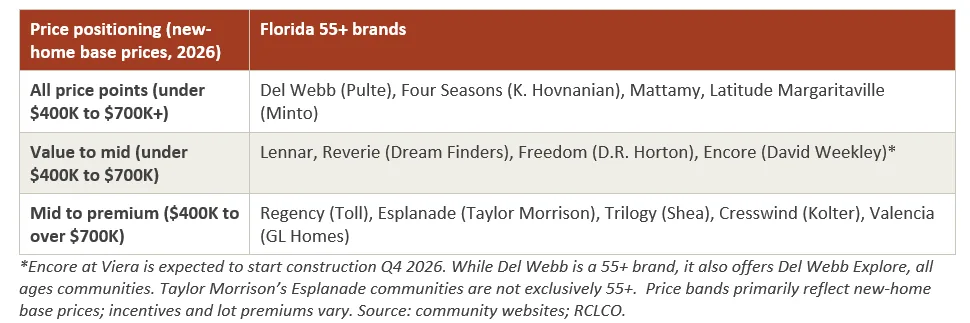
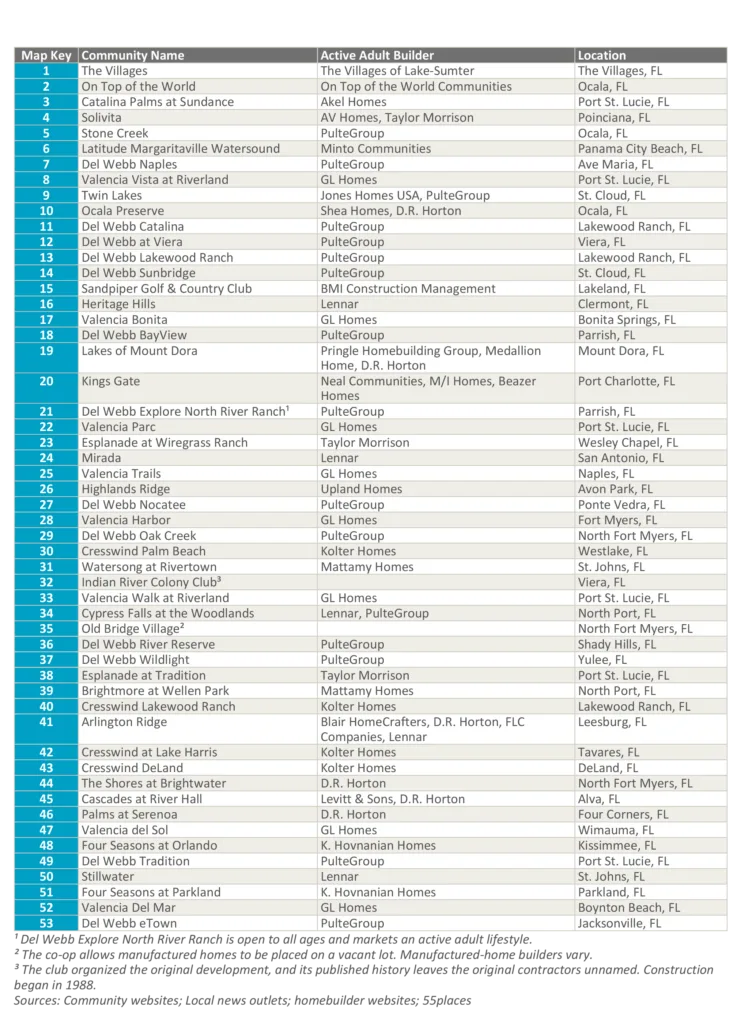
Most major 55+ builder/developers in Florida have followed this approach. Today 13 of the major AAC builder/developer brands listed on the table below build inside MPCs, while five also build (or have built) stand-alone 55+ communities. As shown below, they vary by where they sit on the price spectrum:
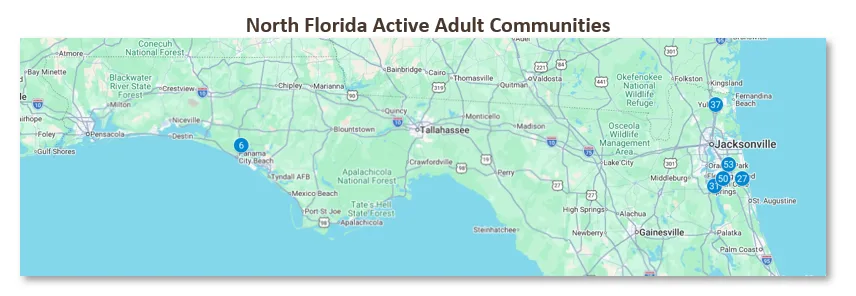
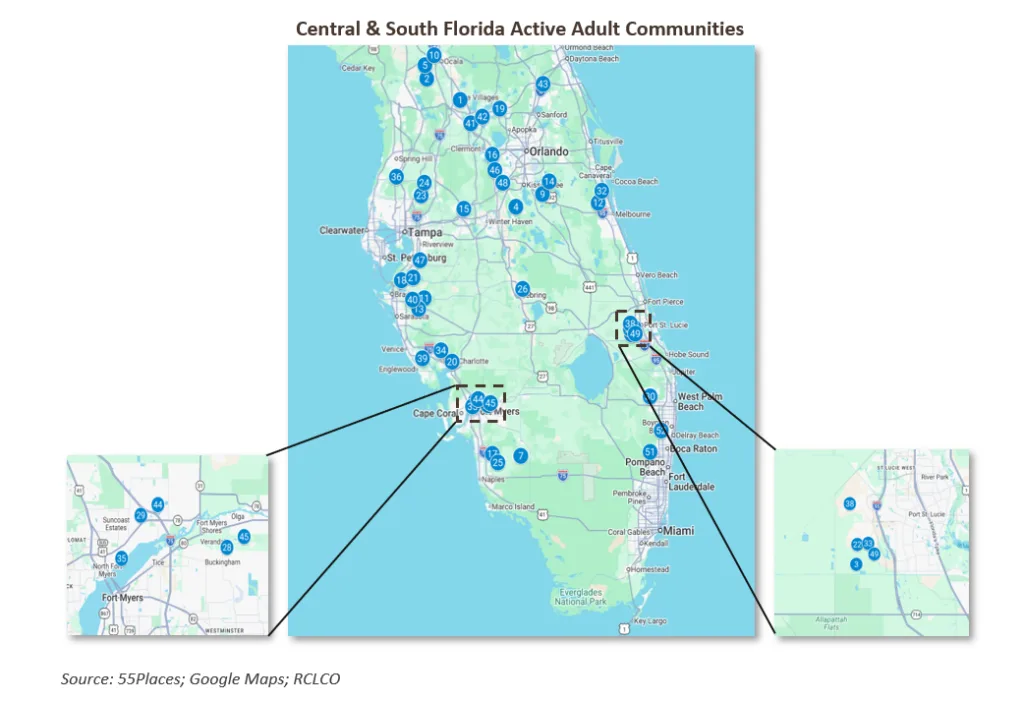
According to the 55places database, there are approximately 3,300 active-adult communities nationwide, including more than 600 in Florida. Those counts encompass a broad range of age-restricted and age-targeted developments, including smaller residential communities. For this advisory we focused on 53 Florida active-adult retirement communities containing at least 500 homes, with most being age-qualified, although we included some non-age-qualified Del Webb Explore and Taylor Morrison Esplanade Communities since they offer a similar lifestyle.
What’s Next
Five themes will shape the next phase of Florida’s active adult market.
- Slower interstate migration, more in-state moves. Florida’s net domestic gain of residents aged 65+ was about 32,000 in 2024, roughly half the 2016 peak of about 62,000. Demand for homes in AAC’s increasingly depends on older Floridians moving within the state, often from expensive coastal areas to more inland counties, such as Sumter.
- MPCs adding AACs, and AACs adding all-ages. Age-qualified enclaves account for more than a quarter of sales in top Florida MPCs, while the big legacy AACs are adding all-ages sections – notable examples include Middleton at The Villages (2023) and Calesa Township at On Top of the World (2021, with about 5,000 homes planned).
- Opportunity for greater price segmentation. The retirement community industry was originally built around attainably priced housing for middle-income retirees, including manufactured homes, condominiums, and relatively modest single-family homes. Over time, the market has shifted toward larger, predominantly single-family detached homes, increasingly elaborate amenities, and higher price points. While this evolution has created successful upper-middle-market and premium communities, it also raises questions about how well the industry serves middle-income retirees. Higher-density housing products, including condominiums, coach homes, villas, and other types of attached homes, may offer opportunities to broaden the market. The challenge is to deliver not simply a lower-priced home, but an attainable total lifestyle package, accounting for housing costs, association fees, amenities, and programming. Communities that can achieve this balance may find a substantial underserved market.
- Expanded amenities. A significant commercial sphere including town centers serve as key amenities, pickleball, resort pools, wellness facilities, expanded dining, educational outlets and greater programming contribute to the lifestyle proposition.
- Lifestyle brands continue building strong and appealing identities that add value and support premium pricing.
Will Gen X Be Different?
As Generation X approaches retirement, builders are examining whether its housing and lifestyle preferences will differ substantially from those of Baby Boomers. Recent PulteGroup research found that 62% of surveyed Gen X respondents preferred living among multiple generations rather than exclusively among people their own age. The findings align with the company’s introduction of Del Webb Explore, which offers the traditional Del Webb lifestyle without an age restriction.
But there is reason to be cautious about interpreting these findings as evidence of a fundamental generational shift.
Del Webb’s own historical research provides an instructive precedent. Its 2010 Baby Boomer Survey found that only 9% of 50-year-old Boomers expressed a preference for age-restricted communities, compared with 20% of 64-year-olds. Yet Boomers subsequently became the dominant market for active adult housing, embracing many of the same lifestyle attributes that appealed to previous generations.
The distinction seems to be less about generation than life stage. Americans are working longer and retiring later than they did several decades ago. Many Gen X households (born 1965–1980, age 46–61 in 2026) are still a decade or more away from retirement. Their housing preferences today are shaped by employment, family responsibilities, and social circumstances that may be quite different when they eventually retire. Therefore it is just as important to look at behavior as it is to study what people say in surveys.
As households enter retirement, the opportunity to live among people at a similar stage of life, establish new friendships, participate in organized recreation, and enjoy a more manageable home may become increasingly attractive. These were important motivations for earlier generations of active adult buyers, and there is little reason to assume they will disappear.
Actual purchasing behavior provides a more useful measure of market demand than hypothetical preferences expressed years before a housing decision is made. PulteGroup’s 2005 annual report identified the average Del Webb buyer as 62 years old, demonstrating that even twenty years ago, purchasers were typically considerably older than the minimum eligibility age of 55. While retirement ages have increased, the available evidence does not establish that the typical age of active adult purchasers has shifted comparably.
Gen X will undoubtedly bring different financial circumstances, recreational interests, and housing expectations to the market. But whether its underlying desire for the social connections, recreation, and lifestyle offered by active adult communities will differ substantially from previous generations remains an open question. The more important consideration for developers may be how to adapt the product to evolving consumer expectations while preserving the fundamental attributes that have made active adult communities successful for decades.
Lifestyle Communities Without Age Qualification
The extension of active adult lifestyle concepts into communities without age restrictions represents an important potential expansion of the active adult segment within the master-planned community market. The underlying proposition is that the recreational amenities, wellness programs, organized activities, and social connections associated with successful active adult communities also appeal to households across a broader range of ages and life stages. These products can attract younger households seeking an amenity-rich lifestyle, older households that prefer a multigenerational environment, and households with family circumstances that make age-qualified living less practical. Importantly, the emergence of these communities need not signal declining demand for traditional age-qualified communities. Instead, they represent an opportunity for builder/developers to reach additional market segments while leveraging established lifestyle brands and programming expertise.
Del Webb Explore and Taylor Morrison’s Esplanade are two examples the extension of the active adult lifestyle to non-age qualified-community development programs. PulteGroup launched Del Webb Explore in 2025, offering the Del Webb amenity and programming community development model without an age restriction. The company has said its research found that 40% of potential Del Webb buyers wanted the lifestyle without the age limit, citing reasons such as helping care for grandchildren, having older children at home, being younger than the traditional active adult buyer, and simply wanting to live among people of different ages. PulteGroup indicates it has positioned the concept toward Generation X buyers, now roughly 41 to 61.
Taylor Morrison had already taken a parallel path with its Esplanade brand of lifestyle communities. The brand’s first Central Florida community, Esplanade at Highland Ranch in Clermont, was age-restricted and has sold out, but since then Taylor Morrison has built Esplanade communities in Florida open to all ages. Their current pipeline, including McKinnon Groves, Westview, Center Lake Ranch and Waterstone has no age restriction. Taylor Morrison has said Esplanade is its strongest-performing consumer segment in 2026.
Conclusion
Over the past century, Florida’s retirement communities have evolved from affordable housing for retirees into a segmented, brand-driven lifestyle business. Products, prices, and amenities have changed considerably, but the underlying appeal has not. From the earliest manufactured-home communities to The Villages, On Top of the World, and today’s Del Webb and Esplanade neighborhoods, successful developers have sold community more than housing: recreation, social connection, and a sense of belonging for people entering a new phase of life. The most successful coordinate housing, amenities, commercial centers, and programming into a coherent lifestyle offering, which is what separates them from conventional subdivisions and supports their long-term brand value.
Three developments will shape what comes next. The shift toward higher-priced single-family homes has opened an opportunity to reintroduce more attainable products. Slower interstate migration makes Florida’s existing older population a more important source of demand. And non-age-qualified lifestyle communities, such as Del Webb Explore and Esplanade, extend the model to a broader audience, blurring the line with all-ages master-planned communities, though those tend to be multi-builder rather than single-builder.
As Generation X approaches retirement, its preferences will influence the next evolution of the market. But Del Webb’s 2010 survey of Boomers is a reminder that preferences stated years before retirement do not always predict behavior. The desire for community, social connection, and a “lifestage appropriate” home may prove more enduring than generational differences suggest, even as the ways builder/developers package and deliver that lifestyle continues to evolve.
Article and research prepared by Gregg Logan, Managing Director. Additional research support was provided by Anthony Innocente, Analyst.
Sources: U.S. Census Bureau; Esri; NAR 2025 Home Buyers and Sellers Generational Trends; Private Communities Registry 2024 Buyer Survey; Florida Chamber Foundation 2026 (via Florida Realtors); Miami Realtors Southeast Florida Housing Wealth Report 2024; HUD; ACS PUMS; Del Webb Sun Cities Museum, Osprey Observer, Tampa Bay Times, Del Webb’s 2010 Baby Boomer Survey, PulteGroup’s 2005 annual report; PulteGroup and Taylor Morrison company disclosures; community websites; Redfin; RCLCO.