“Alexander Kim’s narration really works here — calm, authoritative, and easy to follow. The timing of this release couldn’t be better for strategic planning. 5-star rating!”

February 26, 2026
Have You Heard?
The Strategy Book is now available in audiobook format, providing practical insights to help you craft an enduring strategy for your real estate enterprise—whether you are listening during your morning commute or your evening workout.
Note From the Author
“This book is intended to put you into the appropriate “strategery” zone and guide you through a time-tested approach that has helped hundreds of real estate organizations, large and small, achieve success. It would be presumptuous of me to call this required reading, but if you are a business owner or leader, a member of the C-suite, or otherwise tapped to participate in crafting your company’s long-range strategic plan, then this book will definitely help you organize an effective process and develop a comprehensive plan, whether you decide to self-perform, or engage a professional facilitator, to guide you through this exercise.”
Charlie Hewlett
Strategy for Real Estate Companies: The Nine Essential Pillars of Success for Developers, Builders, and Investors—authored by RCLCO Managing Director Charlie Hewlett and narrated by Alexander Kim—lays out the methods and key steps that real estate owners and managers should take to identify and deliver competitive advantage, optimize their company’s structure, plan for the extreme cyclicality in the business, and in so doing, build consensus and drive performance and profitability.
Some of the key takeaways that you will hear from this one-of-a-kind business book targeted specifically for those in the real estate industry include:
Chapter 1: The Need for a Strategy
Key Takeaways:
- There are a number of key reasons why real estate companies decide to engage in strategic planning, including:
- Growth outpacing the organization’s capacity
- M&A activity and the need/desire to identify best practices and improve efficiency
- Downturns and challenges to growth
- Changes in leadership or ownership
- The desire to create an evergreen company with a legacy vision.
- The duration of a real estate company strategic plan is typically three to five years, but for many companies it may be helpful to plan for a 10-plus-year horizon given the long-term nature of real estate development and investment.
- Think of your company’s strategic plan as a roadmap that defines where you are headed and how you plan to get there.
- Be intentional, and create a thoughtful and comprehensive strategic plan for your organization to succeed.
- Remember that successful strategic plans and companies operate with a conscious consensus among its leadership group and provide clarity and generate buy-in among the individuals and teams that will be tasked with executing the strategy.
- Recognize and plan for the stage in the economic and real estate market cycle that you are currently facing, but also make sure your plan is flexible to respond to inevitably changing real estate cycles.
Chapter 3: Curate a Comprehensive Plan
Key Takeaways:
- The process of planning and ensuring that everyone in the organization is rowing in the same direction is almost as important as the strategy plan itself.
- Ideally a real estate company should revisit its strategic plan every three to five years – however, you should initiate a new strategic planning process in the event of a material change in the company or the external market environment to ensure relevance.
- The most effective planning group is typically six to eight. Have a bias for strategic thinkers, and include representation and/or input from a diverse set of internal company and external resources.
- Create physical separation and head space away from the day-to-day demands of your business to immerse yourself and your team in strategic thinking, this is a different set of “muscles” that needs to be exercised.
- Absolutely focus first on the what and where, but don’t forget the vital how. Your strategy is not complete until you have completed the final implementation strategy pillar that will define how you will put the strategy into motion, including key action items, responsibilities, and deadlines.
- Strategy is not a one-and-done process, and your strategy should be a living and breathing document not relegated to a binder on a shelf gathering dust. It is critical to set up a process to regularly monitor progress, make course corrections as necessary, and revisit the plan if and when the company or the world changes.
Chapter 11: Competitive Advantage Strategy – Winning the Game
Key Takeaways:
- Determine the “short list” of critical core competencies that your company will need to have going forward to succeed in its chosen industry roles, product/segments/services, and market deployment.
- Define what it means to have a competitive advantage in each critical area and determine the metric(s) you will need to measure progress towards achieving a “4” or “5” rating on each.
- Put in place key strategies and action items to maintain your edge on existing areas of competitive advantage, and shore up the ones that may be deficient.
The RCLCO Strategy Process
RCLCO has developed, and continues to perfect, a strategic planning process specifically for real estate companies, including developers, investors, builders, family-owned and operated businesses, capital market participants, and other public and private entities working in the built environment. Much in the same way that McKinsey & Company provides strategic planning and management consulting for corporations and other business organizations worldwide, RCLCO works specifically for companies in the real estate industry.
The Strategy Planning Parthenon (illustrated below) is a helpful way to visualize the RCLCO strategy planning process designed specifically for real estate companies.
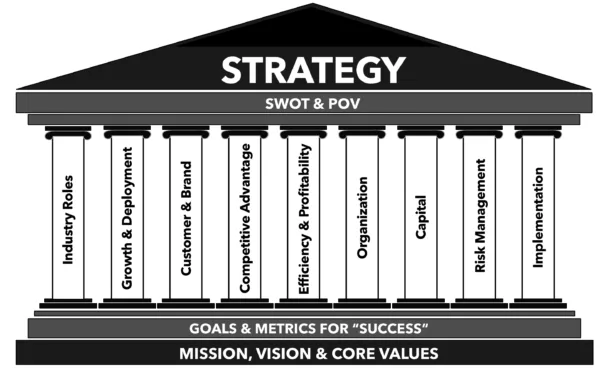
In this extended metaphor, every real estate company strategy, not unlike the Parthenon, should be built on a strong “foundation” of mission, vision, and core values. The first “step” then (which is the first step in the Parthenon graphic) should be determining the key goals and metrics that will be used to define what the “landing zone” is, or what “success” will look like for the company over the strategy plan horizon. It should be designed under the umbrella (or roof) of the company’s understanding of its key strengths and weaknesses and informed by its POV about the internal company and external market environments. The company’s overarching plan should have specific strategies in each of the nine strategy “pillars” that will define what the company will do to achieve its goals and objectives. Depending upon where the company finds itself in the economic and real estate market cycles, the company may emphasize certain pillars more than others; however, a well-rounded plan has multiple strategies in each one of the supporting pillars that are ready to be deployed at the appropriate moments.
The pillars in the RCLCO Strategy Parthenon are arranged in a very purposeful order from left to right for a reason. They start with the Industry Role Strategy pillar (that defines what the company will do), and then move to Growth & Geographic Deployment (where it will be done) on the left, and continue all the way through to Organization (which includes Human Capital as well as structure), Capital (i.e., how to fund the strategy), and finally Implementation (how the job will be completed) on the right side of the structure.
The reason for this is to remind everyone in a visual sense that we need to start with the what and the where without constraints first, then, in an interactive fashion, figure out what we need to do to organize and capitalize the company, and finally how to put the plan into motion with an action plan.
We Invite You to Take a Listen >>
And don’t just take our word for it, here is what some of the most influential people in the real estate industry are saying about the RCLCO Strategy Book:

About the Author
Charlie Hewlett is a Managing Director and Partner of RCLCO Real Estate Consulting, one of the leading real estate advisory firms in the United States. A renowned expert in the field of real estate consulting, strategic planning, litigation support and advisory services, Charlie has an exceptional track record spanning over three decades. With his extensive knowledge and expertise, Charlie has played a pivotal role in shaping the real estate industry and guiding numerous organizations towards success.
Throughout his career, Charlie has consistently demonstrated a deep understanding of market dynamics, investment strategies, and real estate development trends. His ability to analyze complex real estate data and provide insightful recommendations has earned him a stellar reputation among clients and industry peers alike. His strategic guidance has been instrumental in helping RCLCO’s clients make informed decisions, optimize their businesses and portfolios, maximize returns on their real estate investments, and drive company performance.
Charlie is a frequent speaker, lecturer, and content moderator at important industry associations including the Urban Land Institute (ULI), National Multihousing Council (NMHC), National Homebuilders Association (NAHB), and the National Apartment Association (NAA). He has taught undergraduate and graduate level courses and continuing education seminars on real estate development and strategic planning at prestigious institutions including The George Washington University, University of Maryland, Georgetown University, and UNC Kenan-Flagler Business School. He has also been featured in numerous national real estate journals and publications.
The first edition of his book, Strategy for Real Estate Companies, was published in 2008. Charlie is a graduate of Brown University in Providence, Rhode Island, and lives with his wife Nancy in Chevy Chase, Maryland. With his unwavering commitment to excellence and his dedication to the advancement of the real estate sector, Hewlett continues to be a driving force in shaping the future of the industry.
Customer Reviews
“Great follow-up to the original book! The narration is polished and keeps your attention. Ideal listening for executives thinking ahead to the next upturn.”
“Excellent audiobook. I read the original 2023 print version and found the audio even easier to absorb. Alexander Kim’s narration is clear, confident, and well paced. Very timely for firms planning for the next cycle.”
“Listened during my commute and found it easy to stay engaged. Alexander Kim does a great job with complex material. The strategic guidance feels well timed for where the market is heading.”