August 25, 2026
If you only look at the national housing market numbers, you’d conclude these are challenging times. New home sales are down year-to-date. Builder and consumer sentiment are both soft. Mortgage rates are hovering near 6.7%, inflation seems stuck around 3.4%, and the labor market just posted a 23,000-job loss in July with 103,000 jobs of downward revisions to May and June. Builder margins are compressing under the weight of rising incentive use and high construction costs.
And yet, at the same time, the top-selling master-planned communities (MPCs) in the country grew sales 2.9% year-over-year. That’s an 8-point outperformance gap over the broader new-home market, a clear signal that housing consumers who can afford to, prefer MPCs. Current market trends are consistent with historical data showing that MPCs capture a greater share of the market in challenging times.
Why the Best MPCs Keep Winning
The superior lifestyle they offer because of their amenity depth, emphasis on placemaking, product diversity, and scale serves these communities well. In a market where buyers are nervous and builders are competing within an affordability challenged demand pool, a well-run MPC functions as a kind of safe harbor for homebuyers who want certainty about what they’re buying into, and for builders who get a hedge against broader market uncertainty by building inside a place with its own demand engine.
Florida and Texas MPCs Capture the Most Sales
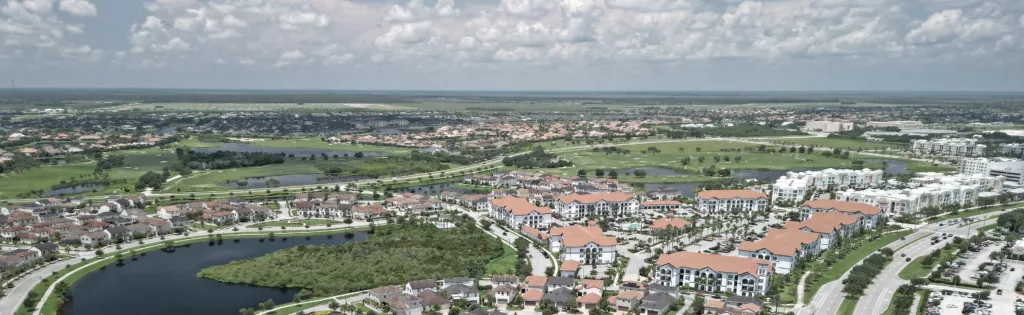
As of July the top 4 best-selling MPCs are all in Florida. For most of the past 6 months Florida’s economic growth outpaced the nation’s. Florida alone captured 44% of all Top-50 MPC sales this year. Add Texas (31% of top MPC sales) and the two states combined account for 75% of the country’s top-selling MPC new home sales volume. The Houston MSA is the top-performing metropolitan area with 9 communities in RCLCO’s Top 50 mid-year ranking.
The top Florida communities include The Villages, Lakewood Ranch at #2 nationally; Wellen Park at #3, with its sales up 37% year-over-year; and another Florida community, Babcock Ranch, rounding out the top four nationally, up 28% over our mid-year 2025 survey. These aren’t new entrants riding a temporary wave, they’re mature, seasoned communities proving that the MPC formula outperforms even when the broader market slows.
More on the Top-Selling Master-Planned Communities
The Migration Story Is Shifting, Not Ending
Both Texas and Florida have seen domestic migration slow from a few years ago. Florida’s population boom has cooled from its 2020–2023 peak, and international migration in particular has fallen off a cliff. But the more interesting story is where the remaining growth is going. The state’s largest, priciest metros are no longer the primary drivers of population growth. Although the migration boom that defined Florida from 2020–2023 has cooled, migration within Florida and relocating to Florida is concentrating in the more attainably-priced, new-construction areas where MPCs tend to be in the State. These include Pasco County where top selling Two Rivers and Mirada are located, Manatee, and Sarasota Counties (Lakewood Ranch, Wellen Park), Charlotte County (home of the Babcock Ranch MPC), St. Johns (Silverleaf, Nocatee), Marion and Sumter Counties (On Top of the World, The Villages).
Florida’s insurance market has been a great cause of concern as rising rates, particularly in coastal areas more vulnerable to hurricanes, has contributed to lower home affordability. Now that is improving, as Statewide rates decreased an average of 8.7% in 2026, helped by tort reform and new carrier entrants. The relief is uneven, as coastal, hurricane-exposed counties are seeing less benefit than inland ones, but it’s nonetheless a positive development.
Challenges Remain
Here’s where I’d urge some caution against reading this good news about MPCs as an all-clear signal. The homebuilders who ultimately buy lots in these communities are still operating in a genuinely difficult environment. National new-home supply remains near 9 months. Existing-home supply is climbing back toward pre-2022 levels, eroding one of the factors that pushed buyers toward new construction over the past few years. And single-family permits are already running below their 25-year average, a sign that builders are pulling back before that pressure fully shows up in lot demand. The top MPC developers are aware that while retail sales pace at the community level has been strong, some builders are carefully recalibrating their inventory and margin expectations, and factoring that into their planning for the balance of the year. With mortgage rates forecast to remain in the 6.5% range through the rest of the year, and consumer sentiment low, it’s hard to see the pace of new home demand growing substantially before 2027.
What to Track Going Forward
As we look ahead, a few indicators will tell us whether this divergence between top MPCs and the broader market holds or narrows:
- Mortgage rates and their effect on buyer affordability (Fannie Mae expects year-end rates around 6.4–6.5%)
- Builder and consumer sentiment, and how it evolves relative to MPC-level demand
- Builder incentive and margin pressure industry-wide, and its effect on delivery pace and pricing
- Builder lot-takedown pace and pricing, as builders weigh their own inventory against demonstrated community-level sales
The headline is real: the best master-planned communities are outperforming a soft national housing market by a wide margin, and Florida is at the center of that story. But the underlying builder economics are worth watching just as closely as the sales numbers themselves. I’d love to hear how others in the industry are seeing this play out in their own markets, so please reach out to me via email.

RCLCO’s 10th Master-Planned Community University
September 15-16, 2026 | Salt Lake City, UT
Goldener Hirsch, Auberge Collection Deer Valley Resort
Limited Seats Remaining
To sign-up for the 2026 MPC University, click the sign-up button below