January 7, 2026
In Summary
- New home sales in Master Planned Communities (MPCs) continue to do better than the market overall. While new home sales overall were down just over 6% at mid-year, Top MPCs had improved by year-end, setting a pace just 3% below the top communities of 2024. This data suggests that MPCs will continue to outperform the market in 2026, given their lifestyle appeal, amenities, and broader mix of housing product, including more attainably priced detached homes on smaller lots.
- The Villages, the nation’s leading active adult community, once again ranked first overall with 3,611 sales.
- Lakewood Ranch in Sarasota, Florida ranked second nationally with 2,085 sales and remains the fastest selling multigenerational community in the country.
- Cadence in Henderson, Nevada earned the third-place rank with 1,247 sales, followed by Babcock Ranch in Punta Gorda, Florida with 1,066 sales, a 34% increase over 2024.
- The Houston MSA was once again the top-performing metropolitan area with 9 communities in the Top 50, representing nearly 6,000 sales, comprising 18% of all sales among ranked MPCs.
- The state of Florida represented 42% of sales among ranked communities, followed by Texas at 32%.
- Looking ahead to 2026, we expect a modest for-sale housing market improvement over 2025, with a moderate increase in total new-home sales, roughly 5%, and low single-digit price appreciation. That assumes mortgage rates remain in a range that does not further erode affordability, and the broader economy avoids a sharp slowdown.
Every year since 1994, RCLCO has conducted a national survey identifying top-selling master-planned communities (MPCs) in each state. This initiative, now in its third decade of continuous publication, exists not only to recognize the most successful communities in the country, but also as a tool for monitoring the overall health of the for-sale housing industry, and a means of highlighting the trends affecting communities large and small. This process also serves as a mechanism through which to learn development best practices and pass along lessons gleaned from the MPCs that have pioneered their way into the top ranks. That information contributes to the knowledge base utilized in RCLCO’s MPC consulting practice. In the following report, RCLCO has surveyed MPCs throughout the country to update the rankings of The Top-Selling Master-Planned Communities of Mid-Year 2025.
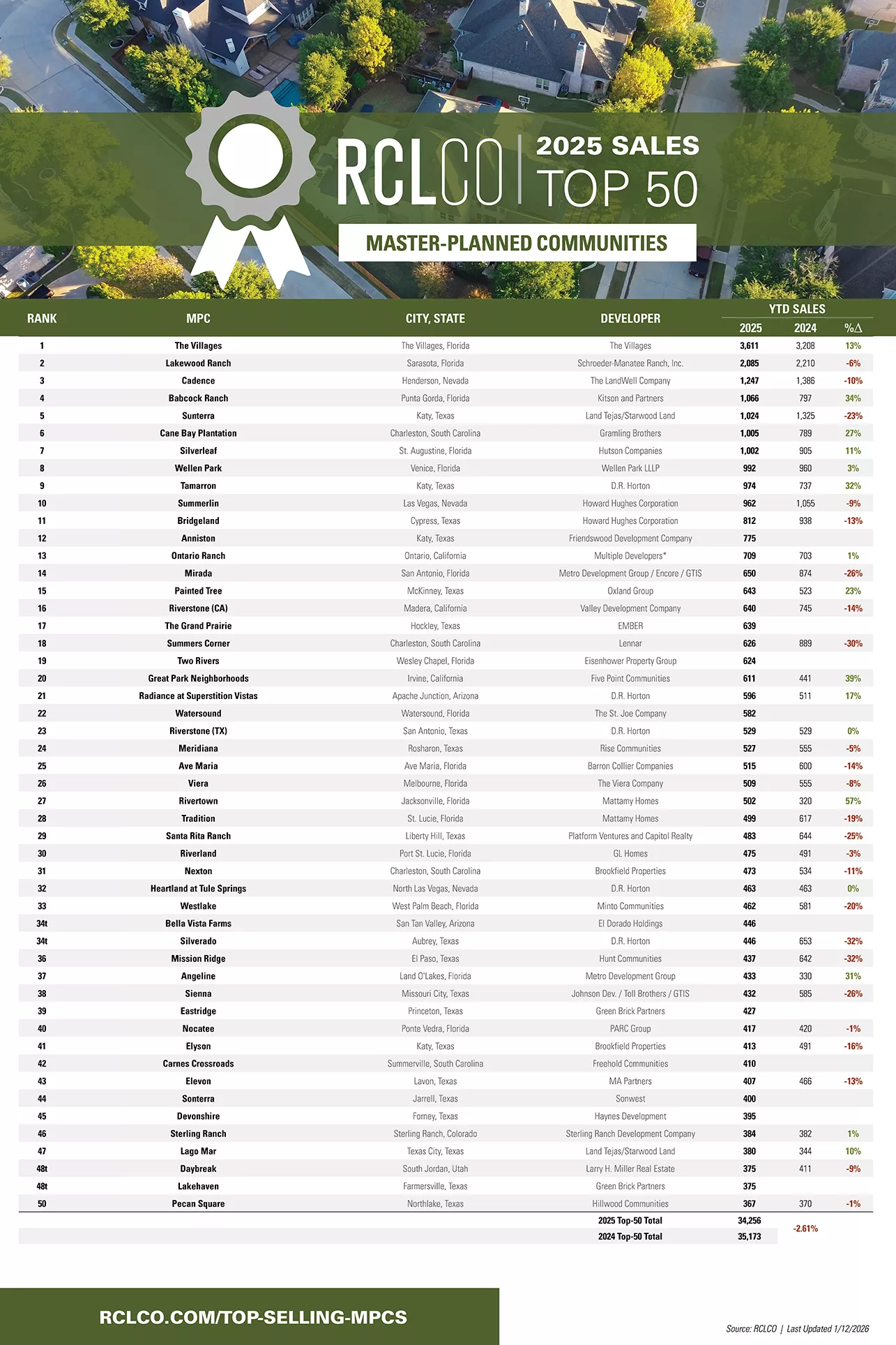
The chart above summarizes RCLCO’s list of the 50 top-selling communities of 2025, including a comparison with their home sales in 2024 where applicable. Sales among the Top 50 communities were 3% below the pace set by 2024 top-sellers. While the official release of national new home sale data has been delayed due to the government shutdown in the fall, this represents a marked improvement over the 6% decline in new home sales seen by the broader market through the middle of the year. The data suggest that MPCs will continue to outperform the market in 2026, given their lifestyle appeal, amenities, and broader mix of housing product, including more attainably priced detached homes on smaller lots.
The Villages in Central Florida is once again the top-selling community in the country with 3,611 sales. Known as the largest active adult community in the country, The Villages now includes Middleton – a neighborhood designed for all ages, though it represents just about 8% of overall sales in the community. Sarasota, Florida’s Lakewood Ranch claims the 2nd place spot in this year’s ranks, with 2,085 sales – the strongest performance in the country among majority-multigenerational communities. Cadence, a LandWell Company community in Henderson, Nevada, earned the third-place rank with 1,247 sales, followed by Babcock Ranch in Punta Gorda, Florida with 1,066 sales, a 34% increase over 2024. The Houston MSA was once again the stand-out metropolitan area with 10 communities ranked within the Top 50, including 5th ranked Sunterra by Land Tejas and Starwood Land. The Houston Metro Area contributed to 6,335 sales among the Top 50 MPCs, representing nearly 20% of all sales among ranked communities.
Forecast for 2026 and Beyond
Looking ahead to 2026, we expect a modest for-sale housing market improvement over 2025, with a moderate increase in total new-home sales, roughly five percent, and low single-digit price appreciation. That assumes mortgage rates remain in a range that does not further erode affordability, and the broader economy avoids a sharp slowdown. As of late December, mortgage interest rates are in the 6.15% range, down from about 6.9% this time last year. The labor market continues to grow slowly, other than the federal government there has been no broad job-loss wave, but job creation is weak by post-pandemic norms. Looking ahead, job growth in 2026 is expected to be modest, though stronger GDP growth later in the year, perhaps in the 2.2% to 2.4% range, could support an uptick in hiring, which would strengthen housing demand.
The government shutdown in the fall has delayed the release of more recent new home sales data, though the Census/HUD numbers through August showed that while year-to-date sales were slightly below last year, recent monthly activity had strengthened. August reached an annualized rate of 800,000 units, the highest in more than two years, and the three-month average was trending up. While preliminary and subject to revision, the August data suggests that although sales in 2025 are down from 2024, there was improvement in the second half of the year.
New home sales in Master Planned Communities (MPCs) continue to do better than the market overall. While new home sales overall were down a bit over 6% at mid-year, with the government shutdown in the fall preventing the release of recent national data, Top MPCs had improved by year-end, setting a pace just 3% below the top communities of 2024. The data suggest that MPCs will continue to outperform the market in 2026, given their lifestyle appeal, amenities, and broader mix of housing product, including more attainably priced detached homes on smaller lots. Community-scale developments will continue to show relative strength and stability compared with standard subdivision developments.
Rate buydowns and closing-cost support will remain essential to capture market share in 2026. Even as rates drift lower, buyers will continue to focus on the monthly payment. The market’s performance will of course vary from region to region, with the South continuing to lead, supported by stronger job growth and relative affordability.
Although we are cautiously optimistic about the market improving in 2026, there is still the risk that a weaker labor market or renewed rate volatility could slow demand. High construction costs are likely to continue to squeeze margins. Yet the fundamentals remain solid: population growth, limited resale supply, and steady interest in modern, efficient homes.
While sales momentum has improved, confidence levels remind us that progress remains fragile. The coming year will not deliver a breakout, but it should offer a manageable path forward.
Key Trends from 10 Years of RCLCO MPC Rankings (2015–2025)
Though economic cycles, interest-rate swings, and demographic shifts came and went, the communities that dominate the top of the rankings share common traits: scale, strategic segmentation, regional concentration, amenity-rich planning, and disciplined execution. Below are five central trends that emerged from ten years of data, and what they reveal about the business and future of master-planned communities.
Trend 1:
Durable Growth with Cyclical Resilience
Even in years marked by macro headwinds, elevated mortgage rates, affordability pressure, or broader economic uncertainty, the top MPC platforms have shown structural resilience. As of year-end 2025, for example, total new home sales among the top 50 MPCs were down only about 3 percent compared to the prior year. At the same time, many high-performing communities continue to outperform the broader market. This is nearly a repeat of 2024, when the entire Top-50 cohort sold 35,173 new homes, only 1.9% fewer than the 35,856 sold in 2023. This recuring pattern underscores how master-planned communities, particularly the top platforms, are structurally better positioned to absorb macroeconomic volatility without collapsing.
The lesson is clear: scale, brand recognition, and long-term institutional planning give MPCs an edge over more fragmented or one-off developments.
Trend 2:
Sunbelt Geography Dominates — Florida & Texas Rule
Geography continues to matter, and over the last decade the data highlight a clear regional concentration. The Sunbelt, especially states like Florida and Texas, has consistently been the epicenter of master-planned community success. For 2025, Florida accounted for roughly 42% of all sales among the top 50 MPCs, with Texas close behind at around 32%.
Within those states, certain metropolitan areas stand out repeatedly. Central Florida (home to The Villages and Lakewood Ranch) remains a powerhouse, while the Houston MSA, notably in Texas, remains a top-performing metro, hosting multiple top-50 communities year after year.
Other sunbelt metros, including Phoenix, Las Vegas, and the broader Nevada region, have also made appearances among top sellers, suggesting that climate, population growth, favorable migration patterns, and affordability are reinforcing a long-term shift toward the Sunbelt.
This regional clustering matters: it suggests that demographic and economic tailwinds favoring the Sunbelt, such as inbound migration, job growth, and preference for warmer climates, play a major role in MPC demand, and that targeting these growth corridors going forward is a valid developer strategy.
Trend 3:
A Small Set of Communities Consistently Deliver Peak Performance
Among the many master-planned communities tracked nationally, a handful consistently remain at the top of the rankings. Over the decade, communities such as The Villages, Lakewood Ranch, and Summerlin have repeatedly ranked high in sales, demonstrating that long-term brand, scale economics, strategic segmentation, and amenity investment all contribute to sustained success.
Take The Villages, for years the top-selling community nationally, with a focus in the 55+ active-adult segment. Its dominance is powered in part by its well-diversified housing offerings and a broad array of amenities.
Lakewood Ranch likewise stands out: it is the nation’s top multigenerational community, serving a wide demographic spectrum, families, retirees, and everyone in between, with all-age neighborhoods, multiple product types, robust open space, extensive trails, schools, commercial centers and community infrastructure.
Summerlin near Las Vegas, with its long history, vital town center and deep amenity base, also continues to draw buyers, demonstrating that legacy communities, when well-maintained and strategically managed, can remain competitive over decades.
These communities show long-term execution discipline, brand identity, economies of scale, and investment in infrastructure and lifestyle amenities matter most when trying to build enduring platforms.
Trend 4:
A Broad Portfolio of Housing Types + Attainability Drives Volume
Over the last ten years, many of the top-selling MPCs have leaned heavily into segmentation, offering a variety of housing types and price points to reach multiple buyer groups. They incorporate a mix of single family lot and home sizes including smaller-footprint detached units, attached housing, townhomes, and more recently include single-family rentals (SFR). This variety helps broaden their market appeal and supports higher volume.
For buyers who may find traditional single-family homes out of reach, young families, first-time buyers, or “missing-middle” households, attached and smaller-footprint options provide a more attainable path. Meanwhile, move-up buyers and empty-nesters can still find larger, premium homes within the same community.
This diversified product portfolio appears to be a key factor behind why master-planned communities, especially all-ages or multigenerational ones, have maintained strong sales even when affordability is squeezed. The mix of housing types and price points makes the community more resilient to shifts in demand or affordability.
For developers launching new MPCs, the implication is clear: offering a range of housing types from entry-level to premium broadens market appeal, increases buyer pool, and supports volume, which is critical for reaching top-seller status.
Trend 5:
Amenities, Placemaking and Lifestyle
One of the most consistent themes across top-performing MPCs is the emphasis on amenity-rich planning and placemaking. Communities that go beyond housing, offering open space, trails, recreation, retail town centers, and some component of walkable mixed-use environment, have gained a competitive edge. Homebuyers are attracted to the top communities because they are buying into a lifestyle. For example, Lakewood Ranch dedicates nearly half its acreage to open space, includes more than 150 miles of trails, top-rated schools, a sports campus, multiple town centers, health-care facilities, and commercial hubs. This kind of planning provides long-term value, and residents enjoy convenience, recreation, and a real sense of community.
Similarly, “classic MPCs” like Summerlin are built around integrated trail systems, parks, open space, and connections to nearby natural amenities such as hiking areas and recreation. Active-adult communities like The Villages lean heavily into social, recreational, and lifestyle amenities.
In an environment of high interest rates, limited affordability, and cautious new home consumers, these lifestyle features help differentiate the best communities. They give homebuyers a reason to pay a premium, but more importantly, they create value that sustains over time, enhancing long-term marketability and resident satisfaction.
What This Means for the Next Generation of MPCs
Looking back over a full decade of top-selling master-planned community data, several lessons stand out for developers, planners, investors, and maybe even for public-policy makers.
- Scale and brand matter. The MPCs that repeatedly top the rankings tend to be large, established, with deeply embedded infrastructure and reputation. For new developments to compete at their level, they need to think long-term, build brand identity early, and commit to infrastructure and amenity investment over time.
- Diverse product mix is critical. The communities that sell best are those that accommodate a range of household types and price points, from first-time buyers to empty nesters to move-up families.
- Sunbelt growth continues. The demographic and economic tailwinds pushing population and job growth into the South and Southwest remain strong. New communities launching today should seriously consider Sunbelt markets, or at least markets with favorable growth, in-migration, affordability, and weather.
- Make it about lifestyle, not just housing. Communities that succeed aren’t just selling homes, they’re marking a lifestyle, made possible by the inclusion of trails, open space, retail, recreation, social hubs, and placemaking that is a powerful differentiator.
- Resilience through cycles. Given macroeconomic uncertainty (i.e. interest rate cycles, housing affordability crunches, etc.) MPCs built on the right fundamentals show durability. For developers and investors, MPCs remain a lower-risk, higher-reward proposition compared to scattered or speculative developments.
The data from 2015–2025 show that successful master-planned communities are well-designed, amenity-forward places capable of attracting a broad mix of consumer market segments, sustaining value, and demonstrate a relatively superior market performance whatever economic cycles come their way.
RCLCO has produced the Top-Selling Master-Planned Community Report since 1994, making it the longest-running publication on master-planned community performance in the industry. The ranking of communities is based on total new home contracts, net of cancellations, as reported by each individual community. Preliminary sales numbers are typically provided by communities in early December, with final sales figures provided during the first week of January. In some cases, sales figures are updated periodically throughout the month of January as communities finalize their records.
To be included in RCLCO’s ranking, MPCs must have several key features. True MPCs are developed from a comprehensive plan by a master developer, and incorporate a variety of housing types, sizes, and prices, with shared common space, amenities, and a vital public realm. The best examples of MPCs are developed with a strong vision and comprehensive plan that guide development and unify the community through distinctive signage, wayfinding, entry features, landscaping, and architectural/design standards. MPCs differentiate themselves from typical suburban subdivisions in terms of scale, as well as in how they provide a means for interaction among neighbors in the sense of the word “community.” They foster an environment within which generations can live better in terms of housing and the community environment, and many MPCs also offer educational opportunities, neighborhood shopping and services, and even employment centers to complement the residential neighborhoods. Although rooted in a vision, the most resilient MPCs have flexible master plans that are environmentally sensitive, market responsive, and nurture the lifestyles of their residents.
Given the above criteria, we do not include the collective sales of multiple, separate communities that are unified only through marketing efforts rather than a preconceived community vision, nor do we include communities that are a collection of subdivisions that have few unifying elements other than name.
More on the Top-Selling Master-Planned Communities
Article and research prepared by Karl Pischke, Principal, and Gregg Logan, Managing Director. Additional research support was provided by Kimberly Asbell, Christopher Bitter, Shanren Brienen, Caitlin Fukumoto, Maggie Henderson, Anthony Innocente, and Alex Valdes.
Disclaimer: Reasonable efforts have been made to ensure that the data contained in this Advisory reflect accurate and timely information, and the data is believed to be reliable and comprehensive. The Advisory is based on estimates, assumptions, and other information developed by RCLCO from its independent research effort and general knowledge of the industry. This Advisory contains opinions that represent our view of reasonable expectations at this particular time, but our opinions are not offered as predictions or assurances that particular events will occur.